

Highlights
Huntress SAT is an add-on, not a platform built specifically for human risk management.
Email remains its primary simulation channel, leaving SMS, voice, and deepfake attacks uncovered.
Continuous risk scoring separates dedicated HRM platforms from campaign-based security awareness training.
8 Best Huntress Alternatives and Competitors (2026)
Huntress is an endpoint detection and response platform first. Security awareness training is a module inside it, not the reason the company exists.
That distinction matters if you're comparing Huntress alternatives, because most of what gets called "Huntress SAT" today started as a feature bolted onto an MDR product in 2023 and expanded with a hands-on "Threat Simulator" addition in 2025.
If you're shopping specifically for phishing simulation and human risk management, you're evaluating a module, not a platform built around the problem. This guide breaks down where that shows up in practice and which alternatives are built for the job from the ground up.
Where Huntress Managed SAT Falls Short as a Standalone Choice
Huntress's own product pages are candid about what Managed SAT is: story-driven training episodes, phishing simulations, and reporting, wrapped into the broader Huntress platform alongside endpoint detection, Microsoft 365 identity monitoring, and a 24/7 SOC. That bundling is the point for Huntress's core MSP and SMB audience. It's also the limitation if awareness training is what you actually need.
A few gaps worth knowing before you shortlist it:
Email-only simulation
Every public description of Huntress's phishing simulation, from the Managed Phishing feature to Threat Simulator, is scoped to email. There's no mention of SMS (smishing) or voice (vishing) simulation anywhere in their own documentation.
Sold as an add-on, not a standalone
Managed SAT ships inside the same portal as Huntress's EDR and M365 identity monitoring. Buying it means buying into Huntress's MSP-first packaging, whether or not you need the rest of the stack.
Episode-based, not continuous
The training model is built around monthly episodes and scheduled phishing campaigns curated by Huntress's research team, not an always-on behavioral risk score that updates as new signals come in.
No agent or AI-delegated risk coverage
Huntress's public materials don't address the risk introduced by employees running AI agents, a gap that's becoming harder to ignore as agent adoption spreads inside the same organizations Huntress serves.
None of this makes Huntress bad at what it's built for. MSPs who want one vendor for endpoint security, M365 monitoring, and basic awareness training get real value from that consolidation. It just means the awareness piece was never the design center.
What to Look for in a Huntress Alternative
Before comparing vendors, it helps to know what you're actually scoring them on. Four things separate a dedicated human risk platform from a bundled training module:
Channel coverage: Attackers don't stop at email. Voice and SMS-based social engineering, including AI-generated deepfake calls, are growing fast enough that email-only simulation tests a shrinking slice of real risk.
Continuous vs. point-in-time measurement: A risk score that updates from ongoing behavior is a different product than a score that resets every time a new campaign launches.
Standalone vs. bundled: Whether the platform was purpose-built for human risk, or assembled as a feature inside a broader security suite, shapes how deep the product actually goes.
Agent and AI-delegated risk: Whether the platform treats an employee's AI agent activity as part of that person's risk profile, or ignores it entirely.
Comparing Huntress Alternatives
Vendor | Channels Covered | Risk Measurement | Standalone or Bundled | Agent/AI Risk Coverage |
Cimento | Email, SMS, voice (deepfake-based) | Continuous, behavior-based | Standalone, AI-native HRM | Unified per-person score, agents included |
KnowBe4 | Email, with newer agent-risk messaging | Campaign-based with risk scoring | Standalone SAT platform | Agent Risk Manager (separate product) |
Hoxhunt | Primarily email | Adaptive, gamified training | Standalone SAT platform | Not a core focus |
SoSafe | Email, some awareness content beyond | Campaign-based | Standalone SAT platform | Not a core focus |
Proofpoint | Email-centric, broader security suite | Campaign-based | Bundled into security suite | Not a core focus |
Adaptive Security | Email, deepfake-focused simulation | Behavior-informed | Standalone, newer entrant | Emerging focus |
Fable Security | Multi-channel simulation | Behavior-informed | Standalone | Emerging focus |
Cofense | Email only | Campaign/reporting-based | Standalone, security-ops focused | Not addressed |
Best 8 Huntress Alternatives to Consider
1. Cimento
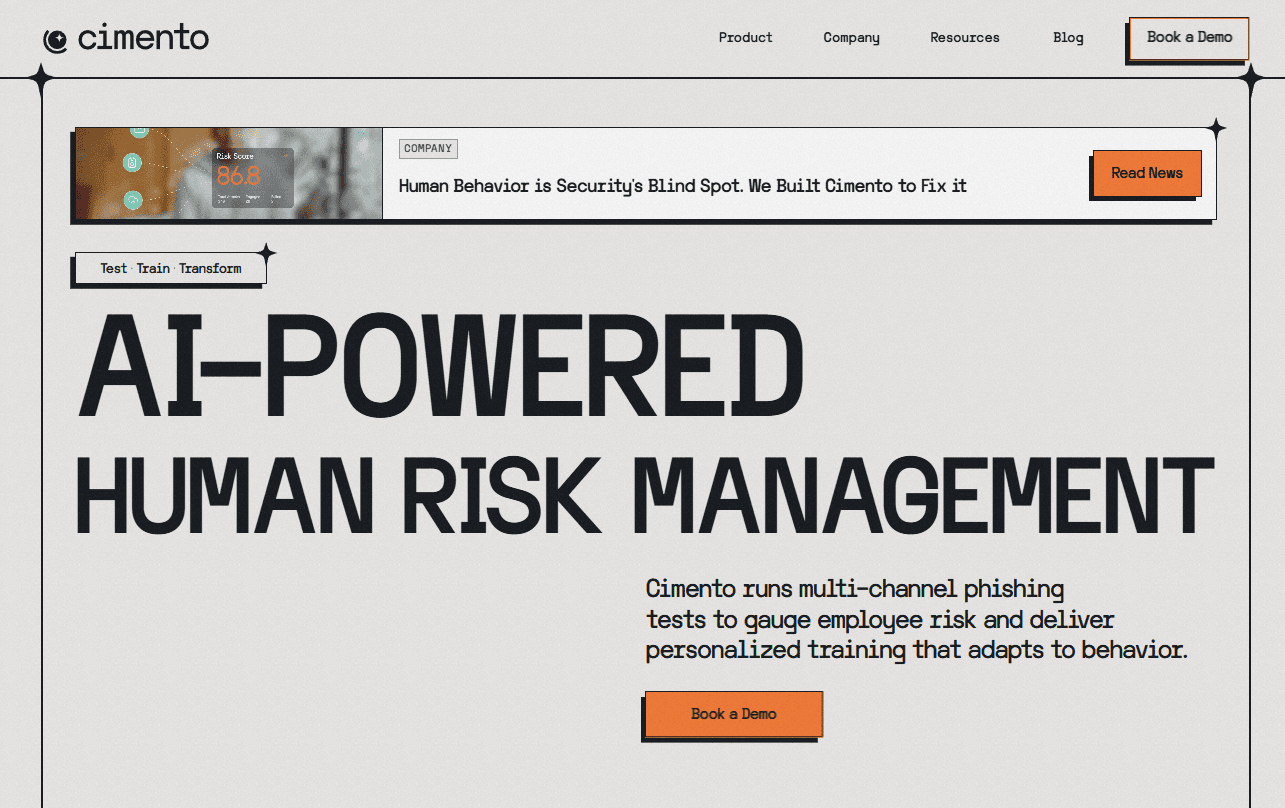
Cimento is an AI-native human risk management platform (HRM) built around a living risk profile for every employee, continuously updated from behavior rather than reset by campaign. It runs multi-channel social engineering simulations across email, SMS, and voice, including AI-generated deepfake scenarios, and extends the same risk model to the AI agents employees operate, since an agent's exposure is a function of the person who configured it.
Where it's different from Huntress: Cimento was built specifically for human risk, not assembled as an add-on to an unrelated security product. Channel coverage extends past email, and agent risk is modeled as part of the same per-person score rather than bolted on separately.
Best for: Organizations that want a dedicated HRM platform rather than awareness training bundled inside an MDR product, especially if voice and SMS-based social engineering are part of the threat model.
2. KnowBe4

KnowBe4 is the largest and most established name in security awareness training, with the broadest content library in the category and recent investment in agent-risk messaging through its Agent Risk Manager product.
Where it falls short: Agent risk is a separate product with its own dashboard rather than an extension of the core per-person score. The platform's depth comes from breadth of content and scale, not from multi-channel simulation.
Best for: Large enterprises that want the most established vendor and the deepest training content library, and that are comfortable managing agent risk as a separate tool.
3. Hoxhunt
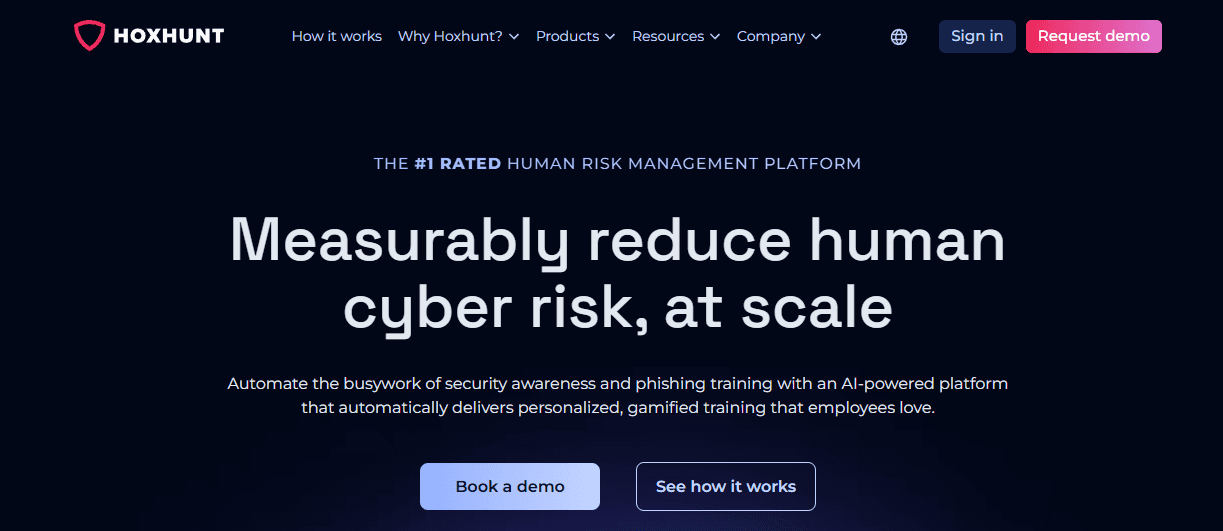
Hoxhunt focuses on adaptive, gamified phishing training that adjusts difficulty to each employee's demonstrated skill level, with a strong emphasis on engagement and completion rates.
Where it falls short: Simulation is primarily email-based, and the platform's strength is training engagement rather than multi-channel risk measurement.
Best for: Teams prioritizing high training completion and engagement metrics over multi-channel simulation depth.
4. SoSafe
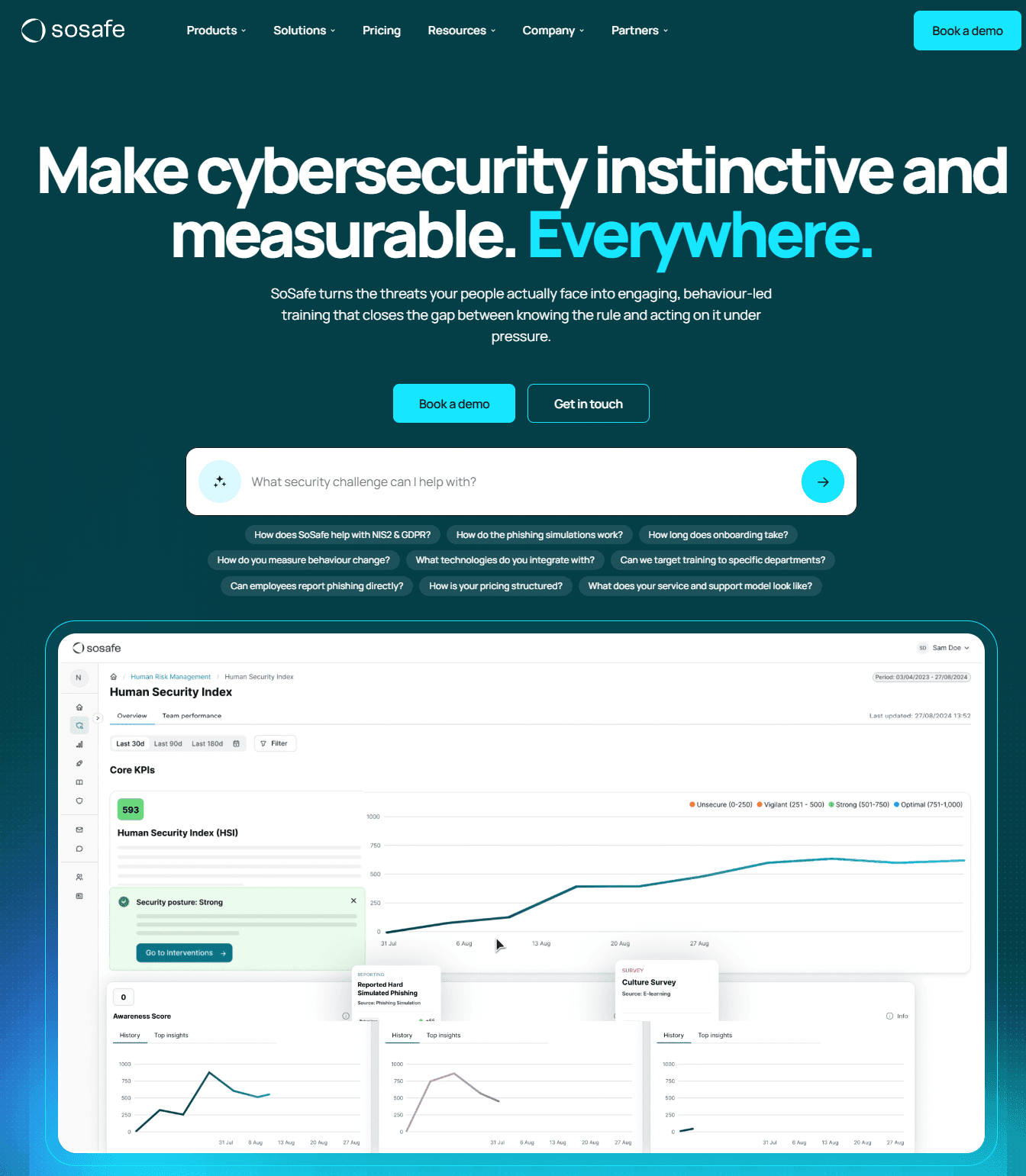
SoSafe is a European-headquartered SAT platform known for localized, compliance-oriented content and strong presence in GDPR-conscious markets.
Where it falls short: Like most of the category, simulation centers on email, and the platform is built around training delivery rather than continuous behavioral risk scoring.
Best for: Organizations with significant European operations that need compliance-aligned training content in multiple languages.
5. Proofpoint
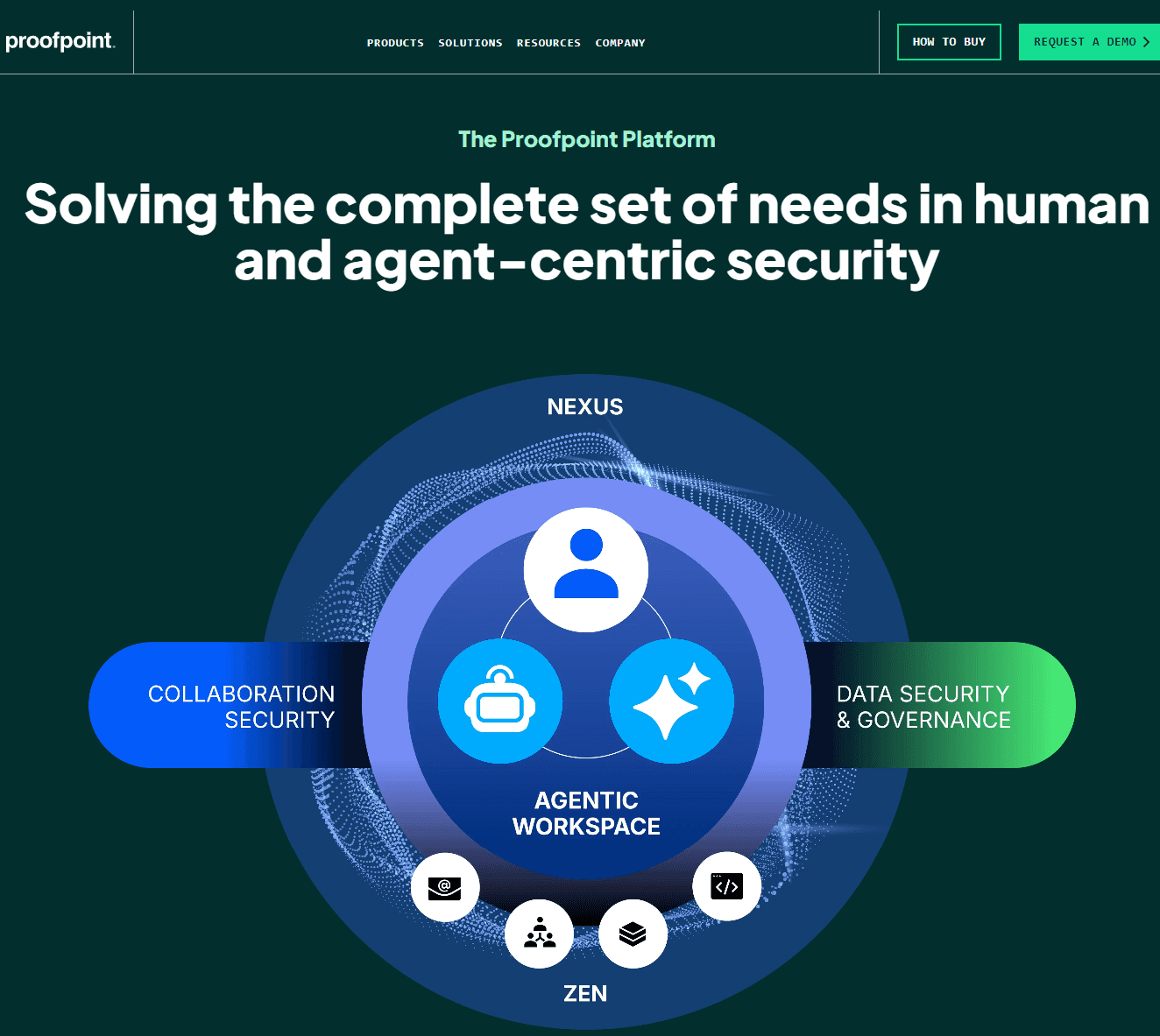
Proofpoint bundles security awareness training inside a much larger email security and threat intelligence suite, giving it deep integration with its own email protection stack.
Where it falls short: Awareness training is one module inside a large product portfolio, similar in structure to Huntress's own bundling problem, just wrapped around email security instead of endpoint security.
Best for: Organizations already standardized on Proofpoint's email security stack that want awareness training from the same vendor.
6. Adaptive Security
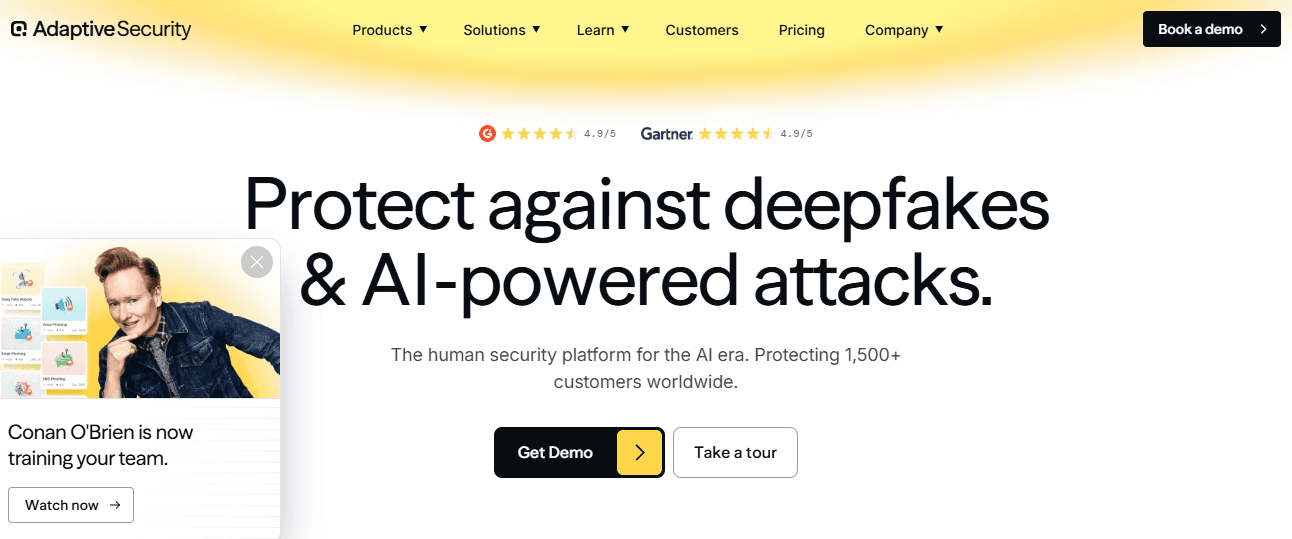
Adaptive Security is a newer entrant built specifically around deepfake-based simulation, reflecting the same shift toward AI-generated attack content that's reshaping the category.
Where it falls short: As a newer platform, breadth of integrations and training content is still catching up to more established vendors.
Best for: Organizations most concerned about deepfake voice and video attacks specifically, looking for a specialist rather than a generalist.
7. Fable Security
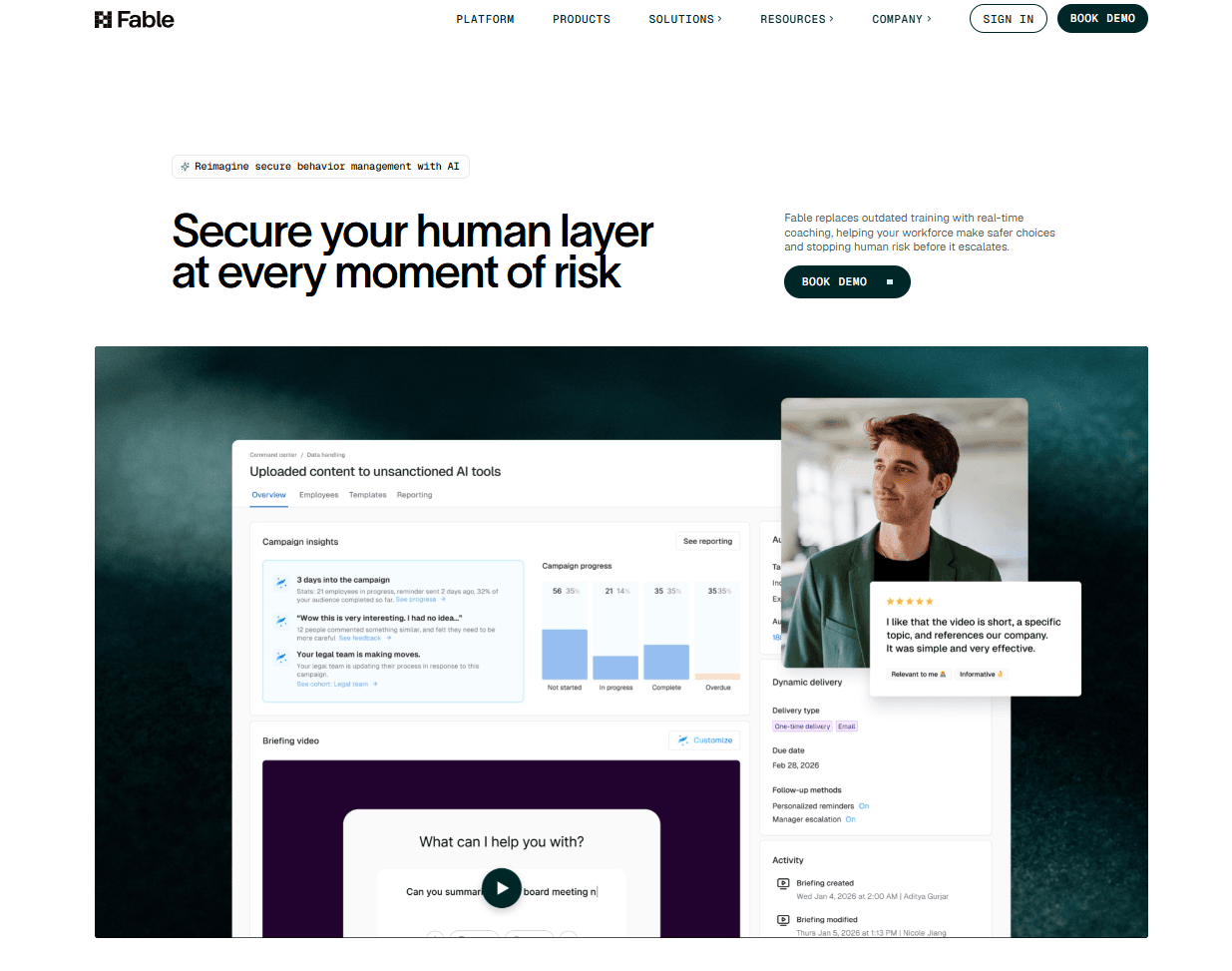
Fable Security runs multi-channel simulation with a behavior-informed approach to risk, positioning itself as a modern alternative to legacy SAT vendors.
Where it falls short: Smaller market presence and shorter track record compared to incumbents like KnowBe4 or Proofpoint.
Best for: Teams that want multi-channel simulation from a newer vendor and are comfortable evaluating a less established name.
8. Cofense
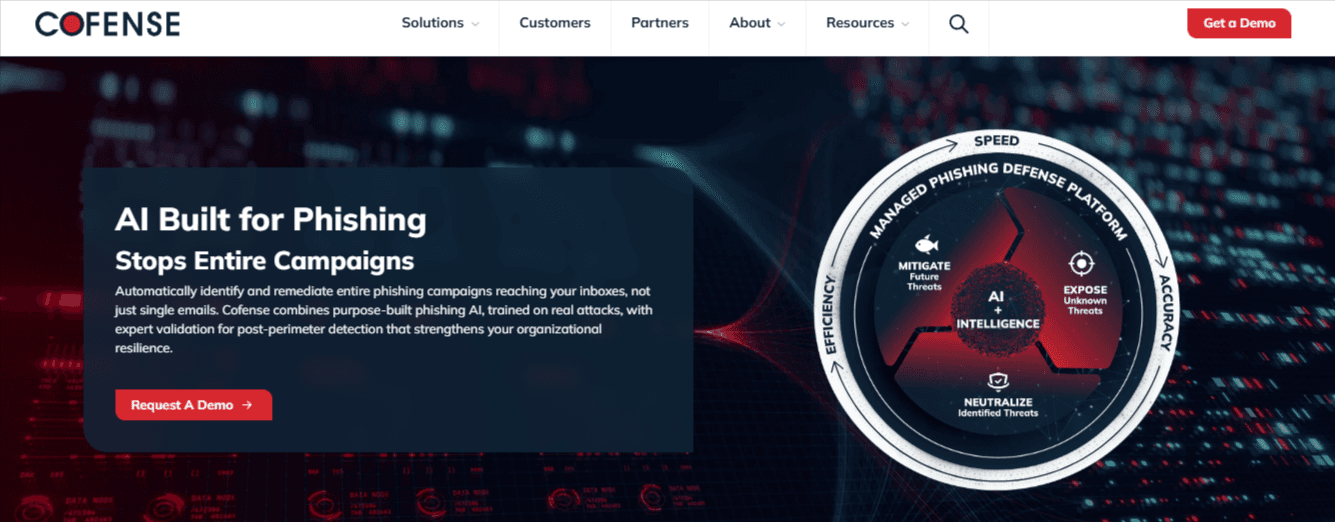
Cofense is a specialist phishing simulation and reporting platform built around one core workflow: realistic email-based simulations paired with an inbox "report this" button that turns trained employees into an active detection layer. That reporter integration feeds Cofense's own triage and threat-intelligence products, so a flagged simulation or real phish can move straight into incident response rather than sitting in a training dashboard.
Where it falls short: The platform is deep but narrow. Simulation and training scope is email-only, with no SMS or voice coverage in its public product documentation. Measurement is built around campaign performance and reporting rates rather than a continuously updated behavioral risk score, and there's no stated coverage of AI agent risk.
Best for: Larger enterprises, particularly in regulated sectors like defense, energy, and financial services, that want deep email-phishing specialization and tight integration with a security operations workflow (SIEM, SOAR, threat intel platforms) over broad multi-channel coverage.
Cimento vs. Huntress
Comparison Area | Cimento | Huntress Managed SAT |
Core Purpose | Built specifically for continuous human and AI social engineering risk management. | Built primarily for MSPs and lean IT teams to manage endpoint detection, Microsoft 365 identity monitoring, and SOC operations. Managed SAT is an extension of that platform. |
Platform Philosophy | Starts with the employee and continuously measures individual risk. | Starts with security operations, with security awareness added as an additional capability. |
Risk Assessment | Creates a living, continuously updated risk profile for every employee based on real behavior. | Focuses on simulation campaigns and training rather than continuous behavioral risk measurement. |
Simulation Channels | Multi-channel simulations across email, SMS, voice, and AI-generated deepfake scenarios. | Primarily email phishing simulations and awareness training. |
Training Model | Continuous, behavior-driven simulations and risk updates. | Episode-based phishing simulations and training campaigns. |
AI Agent Security | Includes AI agent risk by linking every agent to the employee who configured and permissioned it, creating one unified per-person risk model. | No visibility into AI agent risk. |
Risk Scoring | Unified per-person risk score covering both employee behavior and AI agent exposure. | Security awareness metrics focused on phishing performance without AI agent context. |
Best Fit | Organizations that need multi-channel attack simulations, continuous measurement, and unified human + AI risk visibility. | Organizations already using Huntress MDR that want integrated phishing simulation and awareness training within the same security stack. |
Which Huntress Alternative Should You Choose?
You already run Huntress for endpoint detection and just want basic awareness training bundled in: Huntress Managed SAT.
You need the largest content library and don't mind managing agent risk separately: KnowBe4.
Training engagement and completion rates are your top priority: Hoxhunt.
You need compliance-aligned, localized content for European operations: SoSafe.
You're already standardized on Proofpoint for email security: Proofpoint.
Deepfake-specific simulation is your primary concern: Adaptive Security.
You want a dedicated, continuously updated human risk platform that covers email, SMS, voice, and AI agent exposure in one score: Cimento. Book a demo.
Related Read:
Top 10 Hoxhunt Alternatives for Human Risk Management (2026)
8 Best KnowBe4 Alternatives for Human Risk Management (2026)
FAQs About Huntress Alternatives
1. Is Huntress a security awareness training company?
No. Huntress is primarily an endpoint detection and response (EDR/MDR) platform. Managed SAT is a training and phishing simulation module built into that platform, added in 2023 and expanded with additional simulation features in 2025.
2. Does Huntress cover SMS or voice phishing simulation?
Based on Huntress's own product documentation, Managed SAT's phishing simulation is scoped to email. There's no public mention of SMS (smishing) or voice (vishing) simulation.
3. Can you buy Huntress Managed SAT without the rest of the Huntress platform?
Managed SAT is sold as part of the broader Huntress platform alongside endpoint detection and Microsoft 365 identity monitoring. It isn't marketed as a standalone product.
4. What's the difference between a bundled SAT module and a dedicated HRM platform?
A bundled module, like Huntress Managed SAT or Proofpoint's awareness training, is a feature inside a larger security suite built around a different core problem. A dedicated HRM platform is built specifically to measure and reduce human risk, typically with broader channel coverage and continuous, behavior-based scoring rather than campaign-based training.
5. Does any Huntress alternative address AI agent risk?
KnowBe4 has launched an Agent Risk Manager product, but it functions as a separate tool with its own dashboard rather than an extension of the core per-person risk score. Cimento models agent risk as part of the same unified score it already runs for human behavior, since an agent's exposure comes from the person who configured it.
Key Takeways
Evaluate Huntress alternatives based on whether you need bundled awareness training or dedicated human risk management.
Prioritize multi-channel simulations if your organization faces SMS, voice, and deepfake social engineering.
Look for continuously updated behavioral risk scores instead of relying solely on campaign-level results.
Consider AI agent exposure when evaluating the next generation of human risk management platforms.
Choose Huntress when integrated MDR and basic SAT matter most, rather than advanced standalone human risk management.


