

Highlights
AI-generated phishing is no longer unique, making continuous risk visibility the real differentiator.
Most platforms ignore AI agent risk, despite delegated access creating new attack paths.
Campaign-based training misses changing exposure, leaving security teams with outdated risk snapshots.
Continuous Human Risk Management outperforms periodic simulations for measuring real organizational exposure.
Best Adaptive Security Alternatives and Competitors (2026)
Adaptive Security made AI-generated phishing content the standard the rest of the category had to catch up to. Deepfake voice calls, realistic smishing, executive impersonation scenarios built from OSINT, all of it automated. If you're reading this, you've probably already seen the demo and you're wondering what else is out there.
Here's the thing worth knowing before you shortlist anyone: AI-generated content isn't the differentiator it was two years ago. Most serious platforms in this category can produce a convincing deepfake simulation now. The real question is what happens between simulations, and whether the platform accounts for something almost nobody in this space is measuring yet: the AI agents your employees are now running on your behalf.
This guide compares the leading adaptive security alternatives, what each one actually does well, and how to pick the right fit for your team.
Why Teams Are Evaluating Adaptive Security Alternatives
Security teams don't usually go looking for alternatives because the simulations were bad. They go looking because they've started asking a different question. Not "did this person complete the training," or even "how realistic was the phishing test." The question that actually matters is: how exposed is this person right now, and what should we do about it?
That shift exposes three gaps that show up across the category, Adaptive Security included:
Campaign cadence, not continuous measurement
Most platforms, adaptive or not, still run on a training calendar. A simulation goes out, a score comes back, a report gets filed. Risk isn't tracked as it changes; it's sampled a few times a year.
Executive-first design
Deepfake and Open Source Intelligence-driven (OSINT) scenarios are built for high-visibility targets: executives, finance teams, anyone attractive to a whaling attempt. That's real risk, but it's not the whole workforce, and platforms tuned for it can feel disconnected from frontline or operational teams.
Nothing accounts for delegated risk
Every employee with an AI coding agent, browser agent, or automation tool has effectively multiplied their own exposure. That agent has the access the person gave it, and it can be turned against them by nothing more than a paragraph of untrusted text.
Adaptive security alternatives on the market today, including Adaptive Security itself, don't measure this. It's treated as someone else's problem, usually IT or the platform team, when it's really the same human risk question asked about a person's delegated, automated self.
What to Look for in an Adaptive Security Replacement
Before you compare vendors, it helps to know what "better" actually means here. Five things worth checking for:
Continuous risk scoring, not just point-in-time campaign results. Risk changes daily. A platform that only measures it quarterly is always working from stale data.
Multi-channel simulation depth across email, SMS, voice, and deepfake. Table stakes now, but still worth confirming, since some platforms market this more than they deliver it.
Coverage of AI agent and delegated risk. Ask directly: does this platform account for the tools and agents an employee runs, or only the employee's own clicks?
Integration depth with the systems that already carry signal: SIEM, identity providers, HR systems. A platform that can't read live signal is guessing.
Reporting tied to business risk, not completion percentages. A dashboard full of course-completion stats tells you who showed up. It doesn't tell you who's actually exposed.
Top Adaptive Security Alternatives Compared (2026)
Vendor | Core Strength | Multi-Channel Realism | Agent/AI Risk Coverage | Best For |
Cimento | Continuous, behavior-based Human Risk Management | Yes | Yes, measures delegated agent exposure | Teams that want continuous risk visibility across people and their agents |
KnowBe4 | Category incumbent, broad training library | Partial | No | Large enterprises wanting an established, broad-catalog platform |
Hoxhunt | Gamified engagement and culture | Partial | No | Organizations prioritizing participation across a distributed workforce |
SoSafe | UX-led, fast rollout | Partial | No | Teams that want quick adoption with minimal onboarding friction |
Proofpoint | Security stack consolidation | Partial | No | Enterprises already standardized on Proofpoint for email and DLP |
Cofense | Mature simulation library | Partial | No | Teams that want a deep, research-backed template library |
NINJIO | Narrative-driven microlearning | No | No | Organizations wanting short, story-based training content |
1. Cimento: Best Overall Adaptive Security Alternative
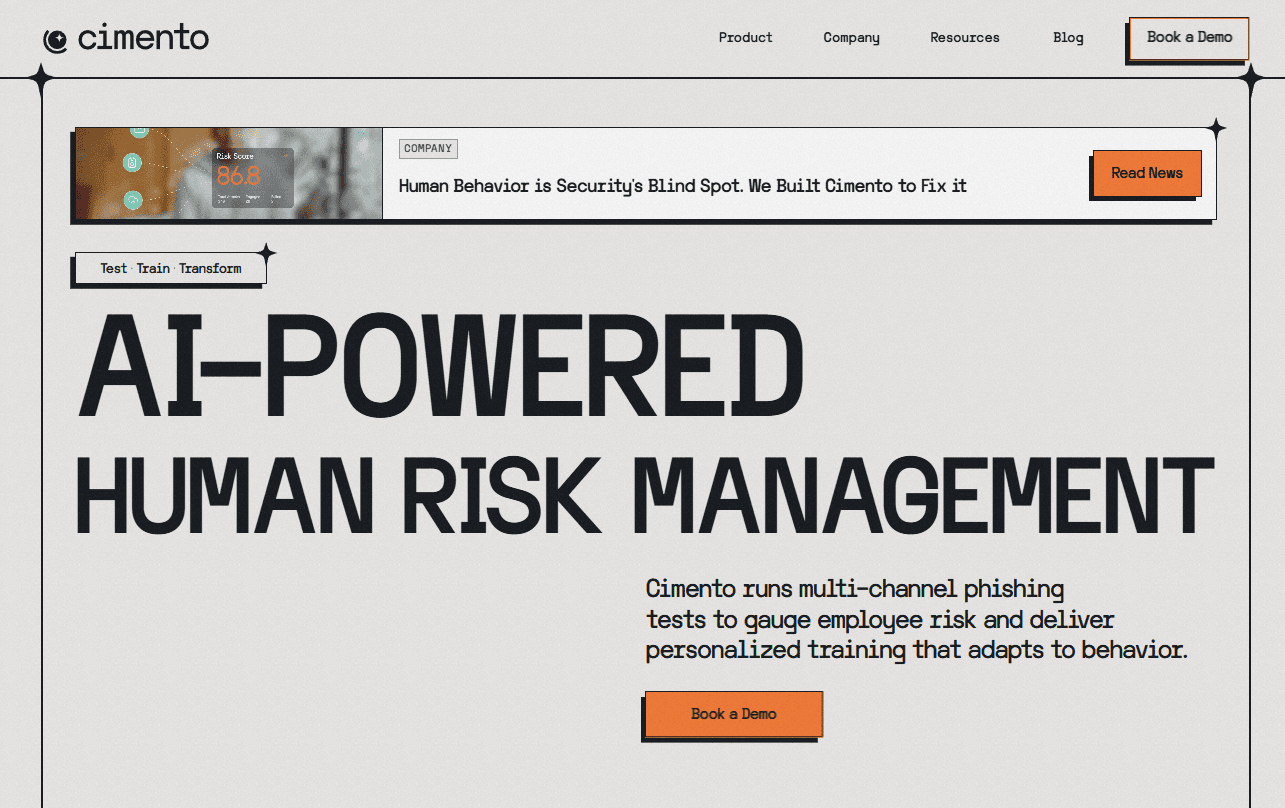
Cimento starts from a different premise than most of this list: agent risk isn't a new category to bolt on, it's the same human risk question applied to a person's delegated, amplified self. Every AI agent an employee runs was pointed at its tools, its repos, its access by that person. The agent's exposure is that person's exposure, executed automatically and at a scale no human could match.
Key differentiators
Continuous, behavior-based risk measurement. Cimento doesn't wait for a campaign to tell you who's exposed. Risk is measured living, in real time, from actual behavior and configuration, not a quarterly snapshot.
Agent risk as delegated employee exposure. Config and telemetry map where each person's agents are exposed. Simulation confirms which of those exposures an attacker could actually trigger. This is a gap nobody else on this list addresses.
Measurement before control. Cimento is a risk company before a controls company. Governance and runtime blocking come once the data justifies them, not as a default reach that slows every employee down to catch the few who are actually exposed.
Multi-channel simulation, covering the email, SMS, voice, and deepfake scenarios that are now standard across the category, without treating realism as the whole story.
Where it outperforms Adaptive Security
Adaptive Security's strength is generating a highly realistic simulation. Cimento's strength is knowing, continuously, who's exposed and why, including exposure created by the AI agents a person runs, and only escalating to training or intervention once that's confirmed.
Ideal for
Security teams that have already adopted AI agents across engineering or operations and want human risk measurement that reflects that reality, not a platform still scoped to email and executive impersonation alone.
2. KnowBe4

KnowBe4 is the category's longest-standing name, with a broad training content library and name recognition that makes procurement conversations easier. It's a safe, well-understood choice for teams that want an established vendor with a wide catalog of pre-built content.
Where it falls short
Its roots are in security awareness training, not continuous risk measurement, and that shows in how risk is scored: mostly through training completion and simulation results, not live behavioral signal.
Ideal for
Large enterprises that want a broad, established content library and are comfortable with a training-first model.
3. Hoxhunt
Hoxhunt leans on gamification and habit-building to keep participation high across large, distributed workforces. Points, streaks, and progression are designed to make security behavior feel routine instead of a once-a-quarter obligation.
Where it falls short
Engagement metrics aren't the same as risk reduction. A workforce that's highly engaged with the training platform isn't automatically a workforce that's less exposed, and Hoxhunt's model doesn't extend to anything outside human-initiated actions.
Ideal for
Organizations where participation and culture-building are the primary success metric, especially across large, global teams.
4. SoSafe
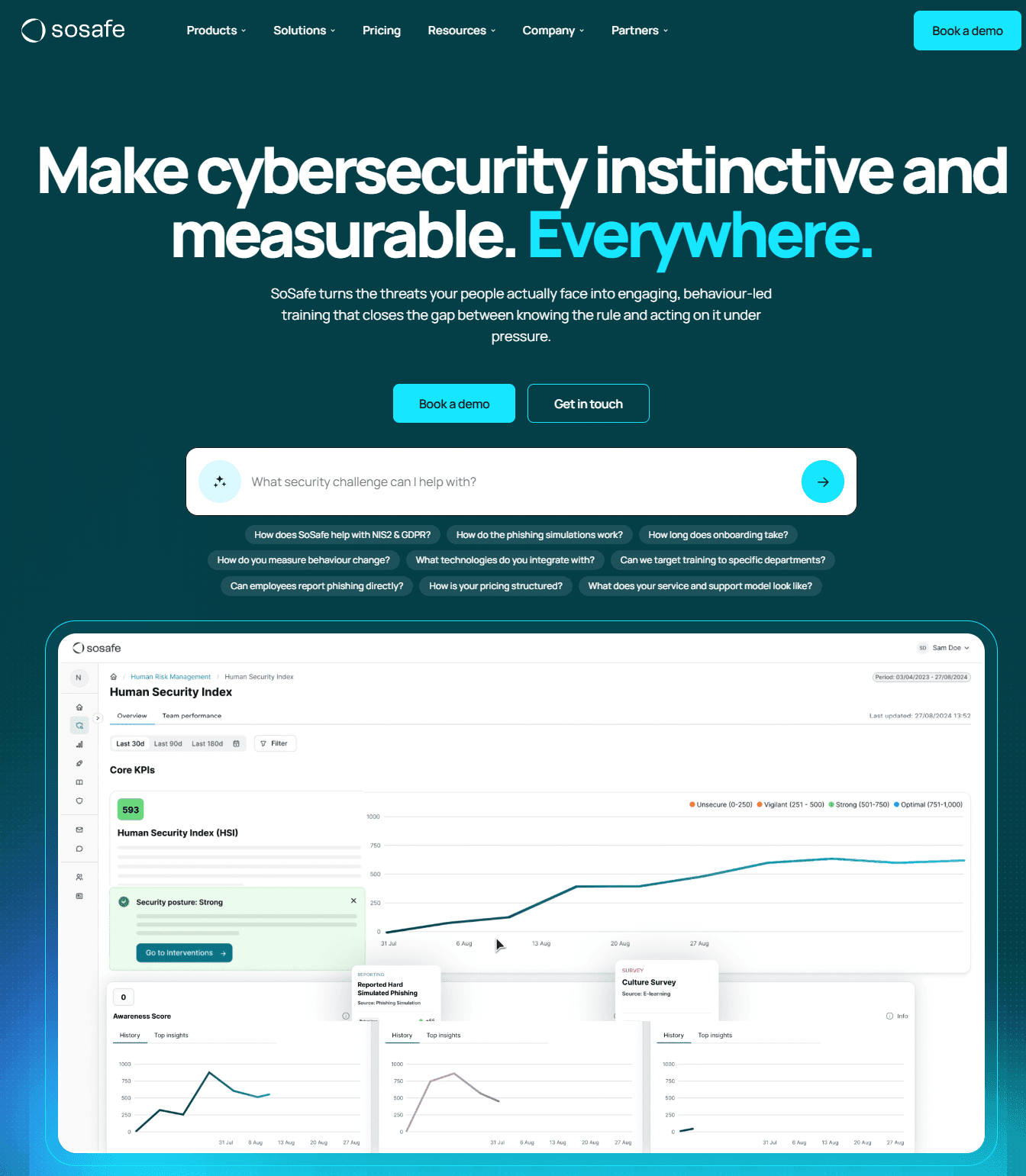
SoSafe is built around ease of adoption. Clean UX, gamified learning paths, and an AI assistant that guides users through content are designed to lower the friction of rolling out a security program quickly.
Where it falls short
The same emphasis on simplicity that makes SoSafe easy to deploy limits how deep its risk analytics and customization go for teams that want granular, behavior-level reporting.
Ideal for
Teams that want to stand up a program fast and prioritize employee experience over deep analytical depth.
5. Proofpoint
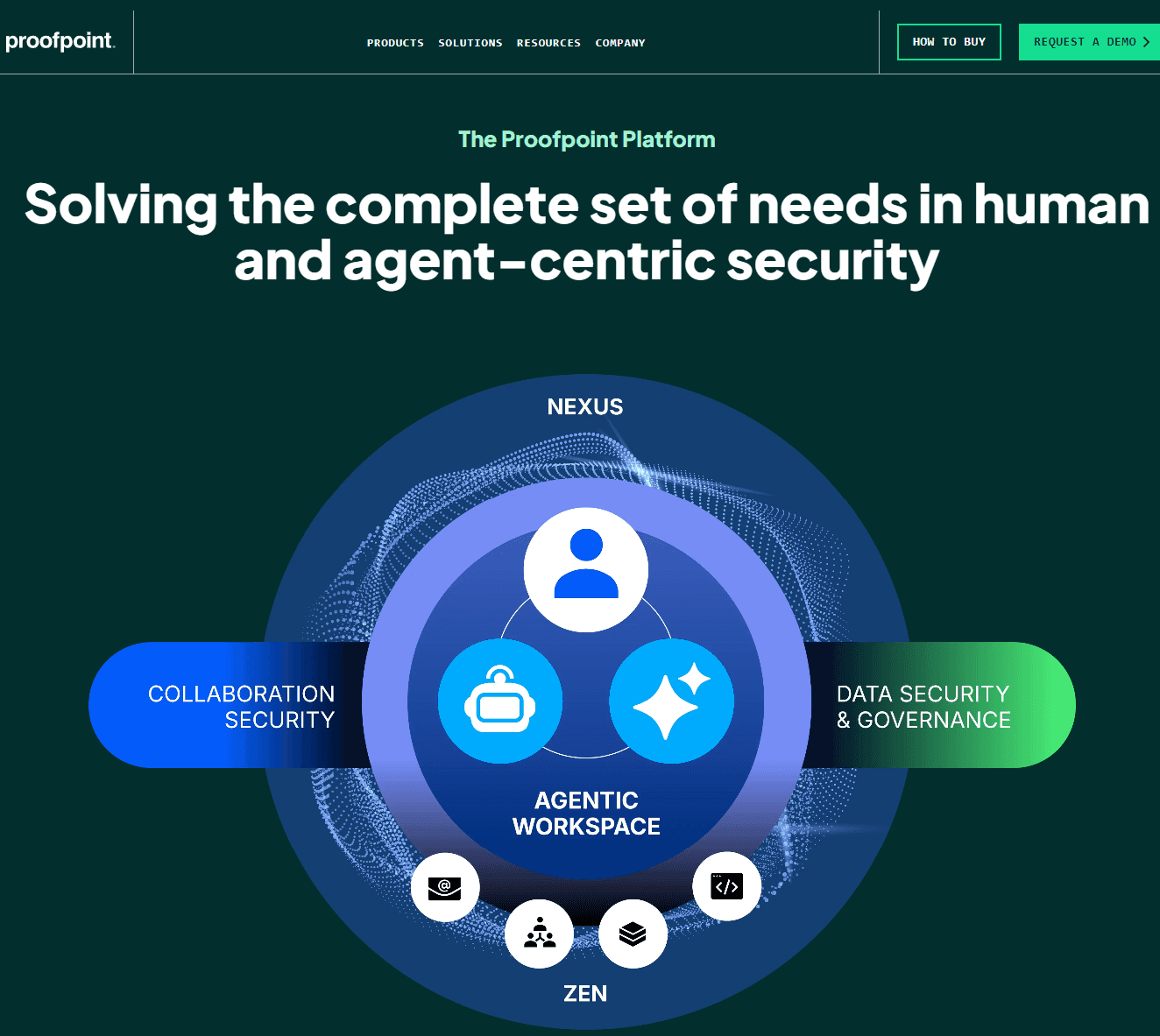
Proofpoint's play in this category isn't training content, it's stack consolidation. For organizations already running Proofpoint for email security and data loss prevention, folding human risk signal into that same ecosystem is the appeal.
Where it falls short
Human risk is treated as an extension of an email security product, not the primary product. Teams that want human risk to be the main lens, not a secondary feature of a DLP platform, will find the scope narrower.
Ideal for
Enterprises already standardized on Proofpoint who want human risk data alongside the email and data-loss signal they already collect.
6. Cofense
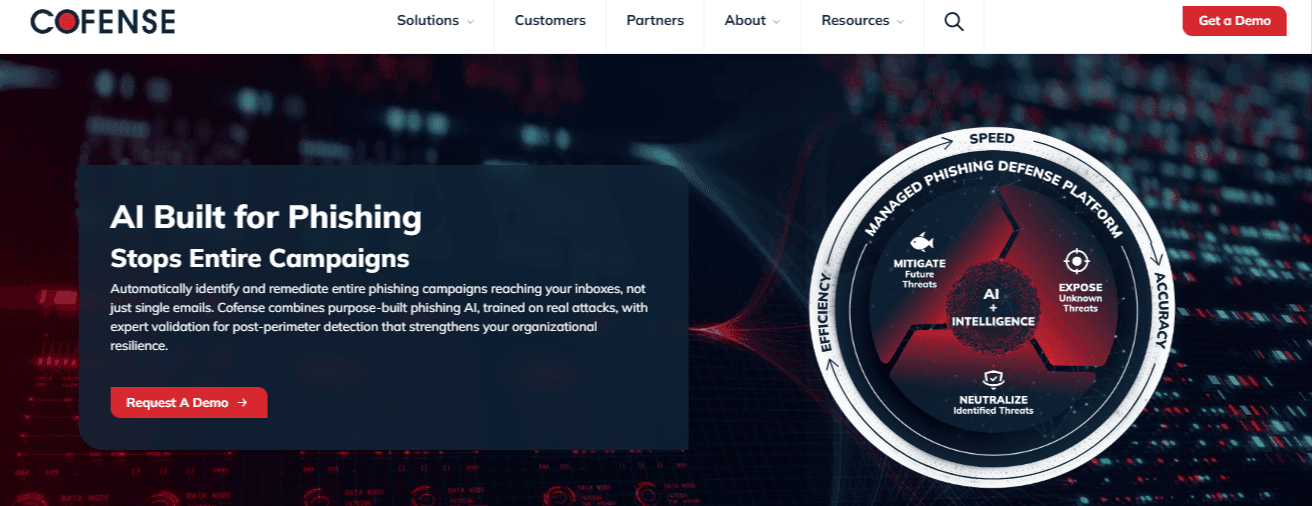
Cofense PhishMe has one of the most established, research-backed phishing template libraries in the category, built over years of real-world attack data.
Where it falls short
Depth of template library doesn't translate to continuous measurement. Teams report that maintaining and rotating simulations takes real administrative effort, and reporting still centers on simulation results rather than live risk scoring.
Ideal for
Teams that want a mature, research-backed simulation library and don't need continuous risk scoring as a core requirement.
7. NINJIO
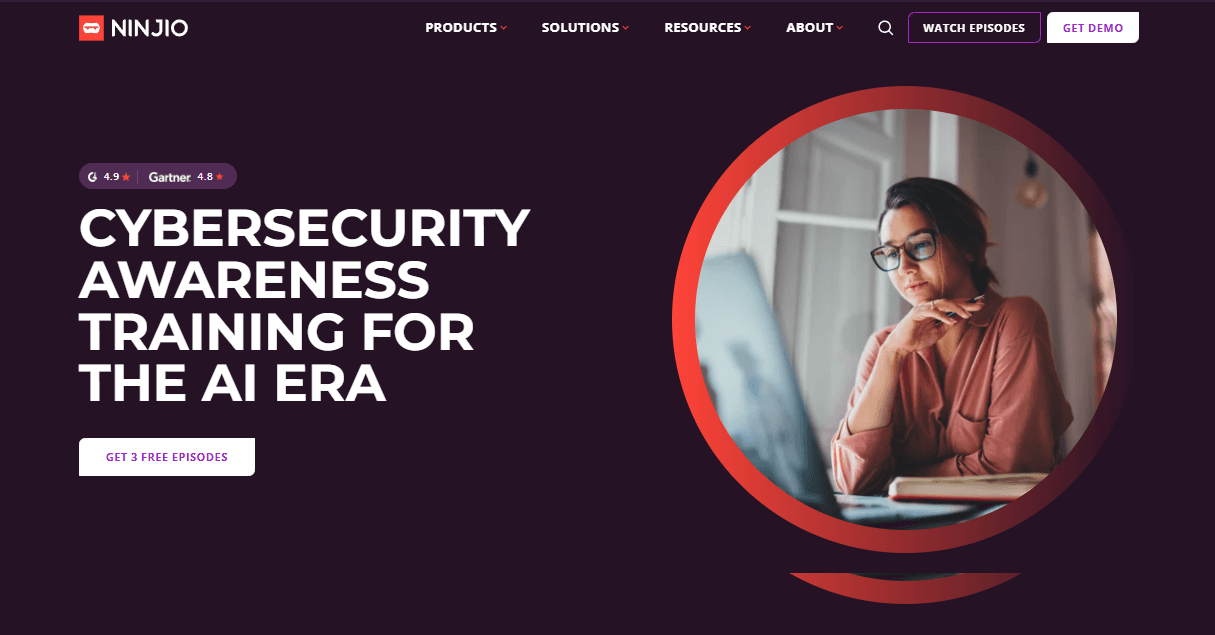
NINJIO takes a narrative approach: short, animated, Hollywood-style episodes designed to make security lessons memorable through storytelling rather than realism or gamification.
Where it falls short
The format is built for recall, not for measuring or scoring real-world exposure. It's a training content choice more than a risk management platform.
Ideal for
Organizations that want engaging, story-driven microlearning content as part of a broader program, rather than a standalone risk platform.
Cimento vs. Adaptive Security
Dimension | Adaptive Security | Cimento |
Simulation channels | Email, SMS, voice, deepfake | Email, SMS, voice, deepfake |
Risk model | Campaign and scenario-based | Continuous, behavior-based |
Executive/OSINT scenarios | Central focus | Covered, not the center of gravity |
AI agent risk | Not addressed | Config, telemetry, and simulation on agent exposure |
Approach to control | Training and simulation-led | Measurement first, controls only where evidence justifies them |
Adaptive Security proved that AI-generated, multi-channel content is achievable at scale. We at Cimento think that realistic content answers only half the question. The other half is knowing, continuously, who's actually exposed, including exposure created by the AI agents a person now runs on their behalf, and Cimento reports this is the gap the rest of the category hasn't closed yet.
Related Read:
Top 10 Hoxhunt Alternatives for Human Risk Management (2026)
8 Best KnowBe4 Alternatives for Human Risk Management (2026)
How to Choose the Right Adaptive Security Alternative
If executive and OSINT-driven threat exposure is the priority, Adaptive Security's existing strengths may already cover it.
If workforce engagement and culture is the goal, Hoxhunt or SoSafe are built around that.
If SOC-native automation matters most, Right-Hand Security is designed to plug straight into existing security operations tooling.
If stack consolidation with an existing email security investment is the priority, Proofpoint is the natural fit.
If the priority is continuous risk measurement that includes AI agents, not just human clicks, Cimento is built around that specific gap.
Whatever you choose, pilot it against a real question: not "did people complete the training," but "do we know more about who's exposed, and why, than we did before this platform." If the answer isn't clearly yes within a quarter, look again.
FAQs About Adaptive Security Alternatives
1. What is Adaptive Security best known for?
Adaptive Security is best known for AI-generated, multi-channel phishing simulations, including deepfake voice and video scenarios built from OSINT, aimed heavily at executive and high-visibility targets.
2. Is there a lower-friction alternative to Adaptive Security?
SoSafe and Hoxhunt are both built around fast adoption and low onboarding friction, prioritizing ease of rollout over deep behavioral analytics.
3. What's the difference between Adaptive Security and traditional security awareness training platforms?
Traditional SAT platforms rely on static content libraries and scheduled campaigns. Adaptive Security differentiates on AI-generated, realistic multi-channel content, but like most of the category, it still measures risk through campaigns rather than continuously.
4. Does Adaptive Security cover AI agent or delegated risk?
No platform reviewed here, Adaptive Security included, currently measures the risk created by an employee's AI agents. Cimento is the exception, treating agent exposure as an extension of the person who configured it.
5. What should I look for in an Adaptive Security replacement?
Continuous risk scoring, real multi-channel simulation depth, integration with existing security signal sources, and, increasingly, visibility into AI agent exposure rather than human behavior alone.
6. How does Cimento compare to Adaptive Security?
Both cover multi-channel simulation. Cimento's difference is a continuous, behavior-based risk model that also accounts for the AI agents an employee runs, an area Adaptive Security's platform doesn't currently address.
Key Takeways
Evaluate platforms on continuous risk measurement rather than the realism of phishing simulations alone.
Ensure your security program covers AI agent exposure alongside traditional human behavior.
Choose a solution that integrates with your existing security stack to provide live risk visibility.
Match the platform to your primary objective, whether that's engagement, compliance, or continuous Human Risk Management.
Validate success by asking whether the platform helps you identify who's exposed and why, not just who completed training.


