
Highlights
Abnormal AI stops at the inbox, leaving SMS, voice, and agent risk uncovered.
Nine alternatives span distinct categories, from training platforms to deepfake and MDR specialists.
Continuous per-person risk scoring goes beyond anomaly detection to measure actual exposure.
9 Best Abnormal AI Alternatives to Choose in 2026
Abnormal Security changed email security by reading behavior instead of matching rules. That's a genuine step forward from static filters. But behavior detection in the inbox isn't the same as managing the person behind the click. You still don't know who's actually exposed, whether that exposure holds up under a real attack, or what's happening on the channels Abnormal doesn't watch. This guide walks through nine abnormal ai alternatives, what each one actually covers, and where the gaps still sit.
What Abnormal AI Does (and Where Teams Hit Its Ceiling)
Abnormal AI’s core strength is behavioral anomaly detection inside email. It builds a baseline of normal communication patterns per employee and flags deviations such as a compromised vendor account, a spoofed executive, a BEC attempt that doesn't trip a keyword filter. For inbox-based threats, that's a real upgrade over legacy secure email gateways.
The ceiling shows up fast once you ask what happens outside the inbox. Abnormal AI doesn't cover SMS or voice, so vishing and smishing sit outside its detection surface entirely. It flags anomalous messages, but it doesn't produce a standing, per-person risk score that tracks how exposed someone is over time. And it doesn't simulate anything and it tells you an email looked wrong after the fact, not whether a given person would fall for a live attack before one happens.
What to Look for in an Abnormal Alternative
Use the same four criteria across every option below, so you're comparing apples to apples instead of feature lists.
Detection scope: email only, or email plus SMS, voice, and other channels attackers actually use.
Behavior-based risk scoring: a one-time flag, or a continuous, per-person score that updates as behavior changes.
Simulation and validation: does the platform test exposure before an attacker does, or only detect after the fact.
Coverage beyond email: does it account for the surfaces employees have added since the inbox stopped being the whole attack surface, including the AI agents they now run.
Abnormal AI Alternatives at a Glance
Vendor | Detection Scope | Behavior-Based Scoring | Simulation/Validation | Beyond Email |
Cimento | Email, SMS, voice, agents | Continuous, per-person | Yes, multi-turn | Yes |
KnowBe4 | Training/simulation | Completion & click-based | Yes, simulation-based | Limited |
Hoxhunt | Training/simulation | Simulation-based | Yes, adaptive | Limited |
SoSafe | Training/simulation | Engagement-based | Yes, simulation-based | Limited |
Fable Security | Training/simulation, AI-native | Limited, not continuous | Yes, simulation-based | Limited |
Adaptive Security | Deepfake-focused threats | Narrow, threat-specific | Yes, deepfake simulation | Deepfake channels |
Huntress | Endpoint/identity (MDR) | Not human-risk focused | No | N/A. Different category |
Proofpoint | Email gateway & DLP | Partial, not core | No | Limited |
Cofense PhishMe | Simulation & reporting | Click/report-based | Yes, simulation-based | Limited |
Abnormal Security | Email only | Anomaly flags, not scoring | No | None |
9 Abnormal AI Alternatives Compared
1. Cimento
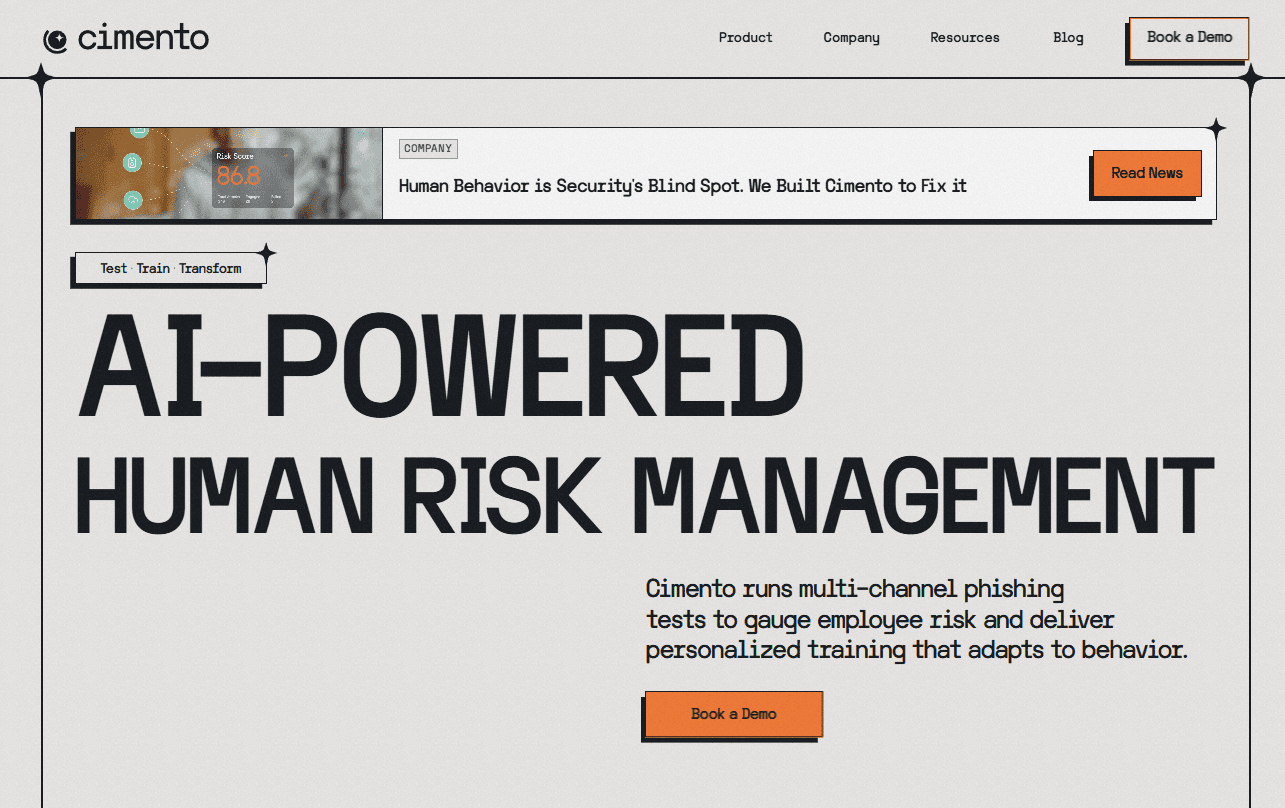
Cimento is built as an AI-native human risk management platform, not just an email detection tool. It runs continuous, behavior-based risk scoring per person across email, SMS, and voice, then validates that exposure with realistic multi-turn simulations instead of guessing from message content alone. The differentiator Abnormal doesn't touch: agent risk.
Every employee who runs an AI agent for connecting them to tools, pointing it at a repo, granting it access, extends their own exposure through that agent. Cimento treats that as the same propensity-and-exposure model it already runs on people, so a person's agent risk shows up in their score, not as a separate, disconnected system. For teams that want an ongoing measure of who's exposed and why, not just a smarter inbox filter, this is the closer fit.
Strengths:
Continuous, per-person risk score across email, SMS, and voice, not a point-in-time flag
Multi-turn simulation that mirrors how attacks actually unfold, rather than single-email tests
Only platform in this list that folds AI agent exposure into the same person-level risk score
Tradeoffs:
Younger company with a shorter public track record than incumbents like KnowBe4 or Proofpoint
No G2 review base yet to benchmark against, since the platform is still building its customer review footprint
Smaller out-of-the-box training content library than long-established SAT vendors
2. KnowBe4

KnowBe4 is the incumbent in security awareness training, with a large simulated-phishing library and broad LMS-style training content. Detection scope leans training-and-simulation rather than live email detection. Risk scoring exists but is largely tied to training completion and simulated-phish click rates rather than a continuous behavioral model. Coverage beyond email has expanded but the platform's roots, and most customer usage, remain training-centric rather than real-time, multi-channel exposure management.
G2 rating: 4.6/5
Strengths:
Largest training content library and market presence in the category, with a long G2 leadership streak
Broad enterprise-scale rollout and integrations (Microsoft 365, Google Workspace, HRIS systems)
High overall review volume gives buyers a deep pool of reference experiences
Tradeoffs:
Risk scoring is tied to completion and click rates rather than a continuous behavioral model
Reviewers commonly note a dated interface and predictable, less-personalized simulations
Detection scope stays training-and-simulation centric rather than live, real-time exposure management
3. Hoxhunt
Hoxhunt focuses on gamified phishing simulation and training, with adaptive difficulty that responds to individual employee performance. That adaptive element gives it a lighter-weight version of behavior-based scoring, tied mainly to simulation outcomes. It doesn't do live email anomaly detection the way Abnormal does, and coverage stays close to email-based simulation rather than extending into voice, SMS, or agent exposure.
G2 rating: 4.8/5
Strengths:
Consistently the top-scoring platform in this list on ease of use, gamification, and phishing-assessment realism
Adaptive simulation difficulty tied to individual performance, not a one-size-fits-all campaign
Large, high-satisfaction review base across both G2 and Capterra
Tradeoffs:
Some reviewers cite repetitive content and a lack of challenge once employees plateau
Coverage stays close to email-based simulation; less depth on voice, SMS, or agent exposure
Behavior-based scoring is tied mainly to simulation outcomes, not a fully continuous risk model
4. SoSafe
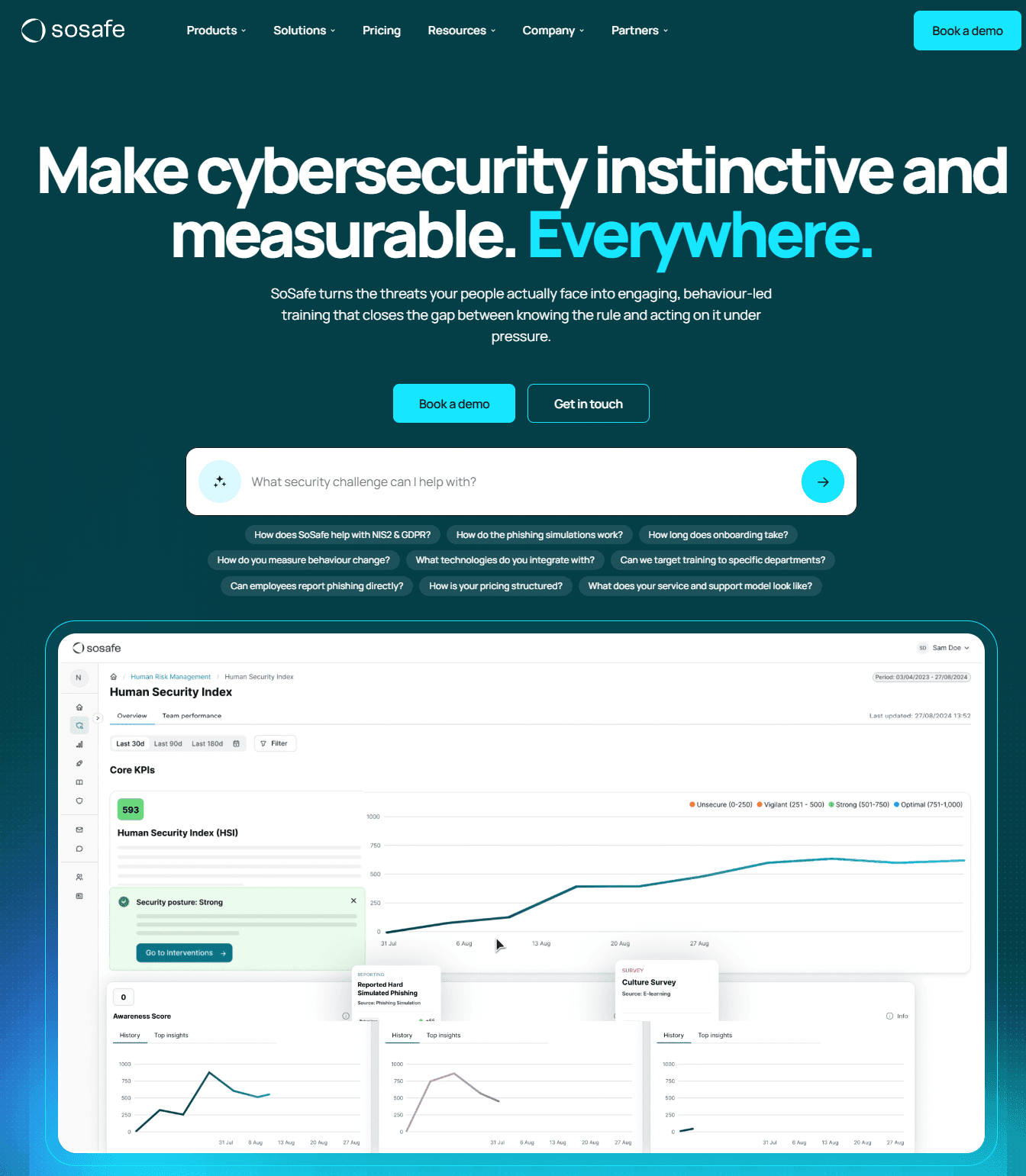
SoSafe is a European-market-strength security awareness platform combining simulated phishing with e-learning content and some behavioral analytics on top. Its detection scope is simulation and training rather than live inbox monitoring. Risk indicators are largely derived from simulation engagement rather than an ongoing, cross-channel exposure score, and coverage beyond email is limited relative to platforms built around continuous measurement.
G2 rating: 4.5/5
Strengths:
Engaging, visually polished content that reviewers consistently flag as easy to adopt
Strong footing in European markets with localized training content
Straightforward rollout with minimal setup friction
Tradeoffs:
Reviewers note simpler reporting metrics than more analytics-heavy platforms
Simulation sophistication rated as less advanced than category leaders like Hoxhunt
Risk indicators come from simulation engagement rather than a continuous, cross-channel score
5. Fable Security

Fable Security markets itself as AI-native security awareness, closer in framing to Cimento's positioning than most legacy vendors. It leans into modern, personalized training content generated with AI. Where it differs is in scope: the emphasis stays on training delivery and simulation rather than a standing, continuously updated risk score, and agent-delegated exposure isn't part of its current framing.
G2 rating: 4.9/5
Strengths:
AI-generated, on-demand content with flexible tone (fully automated or human-driven scripts)
Native Slack integration and in-workflow delivery, reviewers cite meaningfully lifted engagement
Modern, AI-native positioning closer to Cimento's framing than most legacy SAT vendors
Tradeoffs:
Newer entrant (founded 2024) with a thin public review base, so ratings carry less statistical weight
Emphasis stays on training delivery and simulation rather than a standing, continuously updated risk score
Agent-delegated exposure isn't part of its current product framing
6. Adaptive Security
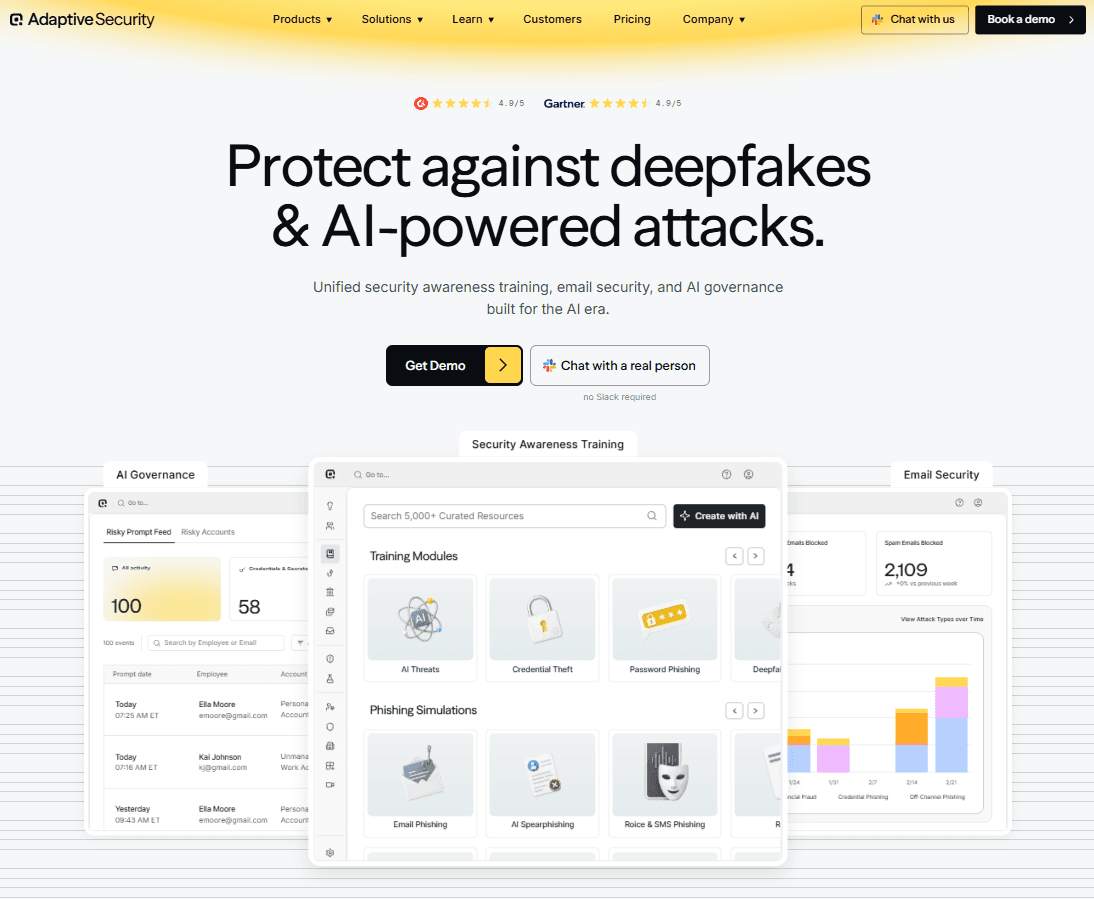
Adaptive Security centers on deepfake and AI-generated threat simulation, a genuinely relevant angle given how much social engineering now involves synthetic voice or video. Detection scope is strong on the deepfake-specific threat model but narrower than a full human risk platform. It doesn't function as an inbox anomaly detector the way Abnormal does, and broader behavior-based scoring across all channels isn't the core of the product.
G2 rating: 4.9/5
Strengths:
Realistic, AI-generated deepfake and multi-channel simulations (email, SMS, voice)
Dynamic human risk scoring with executive-exposure monitoring, reviewers cite the dashboard as a standout
High satisfaction scores despite a smaller review base than category incumbents
Tradeoffs:
Review volume is still small relative to KnowBe4 or Hoxhunt, so the sample is thinner
Strongest on the deepfake-specific threat model; narrower than a full multi-channel HRM platform
Doesn't function as a live inbox anomaly detector the way Abnormal does
7. Huntress

Huntress is primarily an MDR (managed detection and response) platform built for MSPs, with endpoint and identity threat detection as the core offering. It's not built around human risk scoring or phishing simulation at all. It's a different category adjacent to this comparison, useful mainly for teams that already have Huntress for MDR and are separately evaluating human-risk coverage rather than expecting one platform to do both.
G2 rating: 4.9/5
Strengths:
Category-leading satisfaction scores across EDR, ITDR, and MDR — 24/7 human-led SOC reviewers cite repeatedly
Fast, high-touch support and lightweight deployment, especially valued by MSPs and small IT teams
Broad G2 leadership across multiple report categories, not a single-quarter result
Tradeoffs:
Core product is MDR/endpoint and identity detection, not human risk scoring or phishing simulation
Its Managed SAT offering exists but is a smaller part of the platform than EDR/ITDR
Editorial flag: including an MDR-first vendor in an HRM-alternatives list risks reading as an audience mismatch to readers evaluating human risk platforms specifically
8. Proofpoint
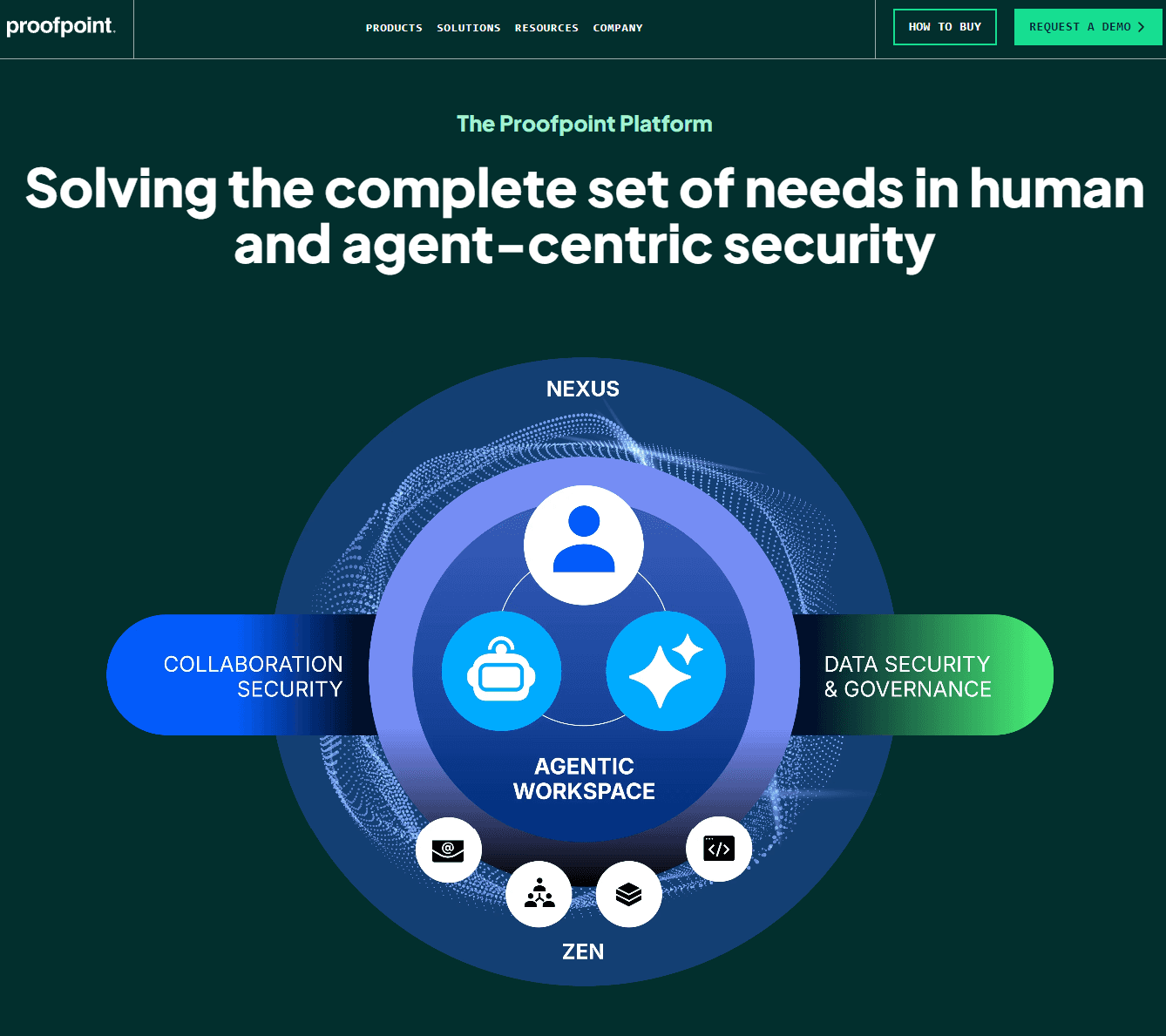
Proofpoint is a large, established secure email gateway and threat protection vendor with deep email filtering, DLP, and threat intelligence capabilities. Detection scope is heavily email-centric, similar in surface to Abnormal but built on a more traditional filtering-plus-intelligence model rather than pure behavioral baselining. Risk scoring exists in parts of the Proofpoint suite but isn't the product's center of gravity, and multi-channel human risk coverage like SMS, voice, agent exposure, sits outside its core offering.
G2 rating: 4.5/5
Strengths:
Deep, mature email filtering, anti-spam/anti-malware, and DLP capabilities reviewers rate highly
Large enterprise install base and long track record in the email security category
Strong quarantine and real-time detection features for inbox-level threats
Tradeoffs:
Detection scope stays heavily email-centric; multi-channel human risk coverage (SMS, voice, agent exposure) sits outside its core offering
Risk scoring exists in parts of the suite but isn't the product's center of gravity
Some reviewers note a steeper learning curve than lighter-weight, purpose-built HRM platforms
9. Cofense PhishMe
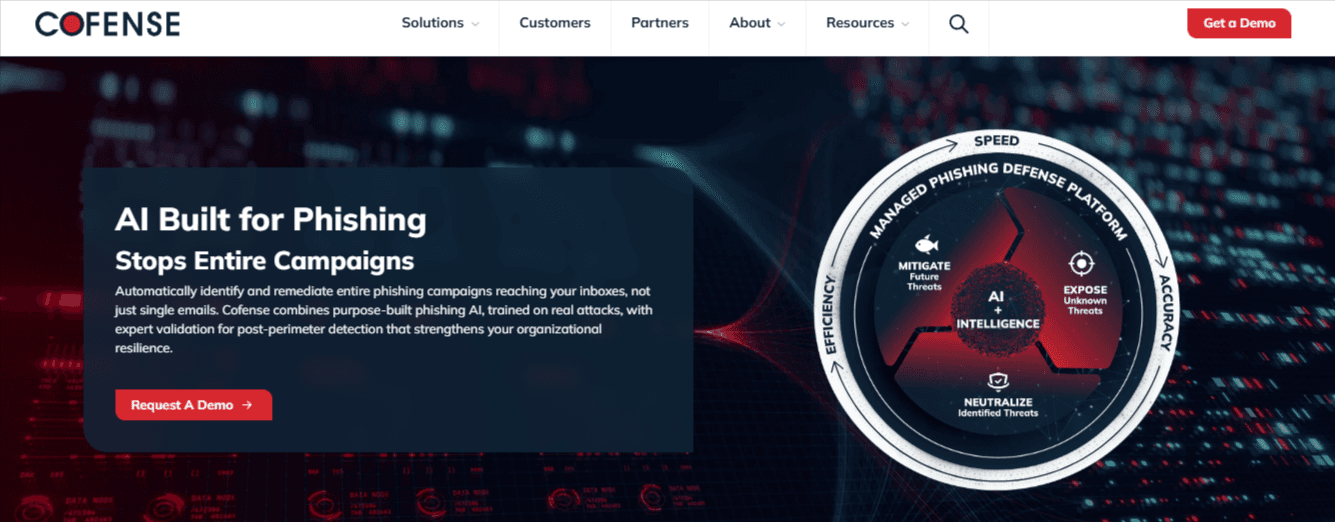
Cofense PhishMe is a long-standing phishing simulation and employee-reporting platform, often paired with Cofense's separate threat intelligence products. Detection scope centers on simulated phishing campaigns and a reporting workflow for real suspicious emails, not live behavioral anomaly detection. Scoring is tied to simulation click and report rates rather than a continuous cross-channel risk model, and coverage doesn't extend to voice, SMS, or agent risk.
G2 rating: 4.1/5
Strengths:
Simple, customizable phishing drills with a strong front-line employee-reporting workflow
Long-standing presence in the category with an established simulation library
Pairs with Cofense's separate threat intelligence products for teams already in that ecosystem
Tradeoffs:
Thin, inconsistent public review coverage across sources makes the rating harder to pin down confidently
Scoring is tied to simulation click/report rates, not a continuous cross-channel risk model
Coverage doesn't extend to voice, SMS, or agent risk
Vendor | Detection Scope | Behavior-Based Scoring | Simulation/Validation | Beyond Email |
Cimento | Email, SMS, voice, agents | Continuous, per-person | Yes, multi-turn | Yes |
KnowBe4 | Training/simulation | Completion & click-based | Yes, simulation-based | Limited |
Hoxhunt | Training/simulation | Simulation-based | Yes, adaptive | Limited |
SoSafe | Training/simulation | Engagement-based | Yes, simulation-based | Limited |
Fable Security | Training/simulation, AI-native | Limited, not continuous | Yes, simulation-based | Limited |
Adaptive Security | Deepfake-focused threats | Narrow, threat-specific | Yes, deepfake simulation | Deepfake channels |
Huntress | Endpoint/identity (MDR) | Not human-risk focused | No | N/A. Different category |
Proofpoint | Email gateway & DLP | Partial, not core | No | Limited |
Cofense PhishMe | Simulation & reporting | Click/report-based | Yes, simulation-based | Limited |
Abnormal Security | Email only | Anomaly flags, not scoring | No | None |
Why Teams Choose Cimento Over Abnormal
Abnormal answers one question well: did this email look wrong? Cimento answers a different, broader one: how exposed is this person right now, across every channel they actually work in, and what should we do about it? That includes the channels Abnormal was never built to watch SMS, voice, multi-turn social engineering that unfolds over several messages instead of one, and it includes agent risk, which barely exists as a category for most vendors in this list.
Employees now run AI agents with real permissions and real access. Cimento treats each person's agent exposure as part of their existing risk score, measured through config, telemetry, and simulation, before reaching for governance controls. That's the gap Abnormal, and most of the vendors above, don't currently address.
Summing It Up
Abnormal Security is a real improvement over rule-based email filters, but it's still an inbox tool solving an inbox problem. If your risk surface has grown beyond email, an email-only detector won't show you the full picture. The Abnormal AI alternatives above range from training-focused platforms to a narrower deepfake specialist to a different category entirely in Huntress. If what you need is a continuous, per-person view of human risk across every channel, see how Cimento measures it.
Related Articles:
8 Best KnowBe4 Alternatives for Human Risk Management (2026)
Top 10 Hoxhunt Alternatives for Human Risk Management (2026)
FAQs About Abnormal AI Alternatives
1. Is Abnormal Security good for phishing simulation?
No. Abnormal is built for behavioral email detection, not simulation. It doesn't run simulated phishing campaigns or test employee response to attacks and for that, you'd need a dedicated simulation or human risk management platform.
2. What does Abnormal Security not cover?
Abnormal doesn't cover SMS or voice-based attacks, doesn't produce a continuous per-person risk score, and doesn't account for AI agent exposure. Its detection surface is limited to email.
3. What's the best HRM alternative to Abnormal Security?
It depends on what you need. For continuous, behavior-based risk scoring across email, SMS, voice, and agent exposure that can be validated through simulation rather than detection alone, Cimento is built specifically for that gap.
4. Does Abnormal Security handle SMS or voice-based attacks?
No. Abnormal's detection is scoped to email. Smishing and vishing sit outside what the platform monitors.
Key Takeways
Define whether you need better email detection, employee training, or continuous human risk management before comparing alternatives.
Evaluate coverage across SMS, voice, deepfakes, and AI agents instead of focusing on email alone.
Prioritize continuous behavioral risk scoring when you need to understand who is exposed and why.
Use realistic simulations to validate employee exposure before attackers exploit it in a real campaign.
Choose a platform based on the specific gap in your security stack rather than assuming one category solves every problem.