

Highlights
True HRM measures behavior, not training completion, giving continuous visibility into human risk.
Multi-channel simulations reveal real-world risk better than email-only phishing tests.
The best platforms automate interventions using live risk scores and behavioral signals.
Vendor choice depends on your security priorities, from AI-native HRM to compliance and email ecosystems.
9 Best Human Risk Management Platforms in 2026
Ask ten vendors what human risk management means and you will get ten different answers, and at least half of them will sound suspiciously like security awareness training with a new coat of paint. That is the real challenge in picking from the best human risk management platforms in 2026: the category grew faster than the vocabulary describing it. Everyone claims a risk score now. Not everyone has one that means anything.
This guide breaks down ten platforms worth evaluating, what each one actually measures, and where the real differences sit once you get past the landing page copy. We will start with what separates genuine HRM from rebadged training, then walk through the vendors.
What Actually Makes a Platform Human Risk Management (Not Just Training With a New Label)
Here is a better question than "did they finish the training." How likely is this person to be attacked right now, and what should you do about it?
That question is the whole point of human risk management. Security awareness training answers a different question: did the employee sit through the video? Those are not the same thing, and the gap between them is where most breaches still happen. Roughly nine in ten incidents involve a human element, and two decades of completion-tracking has not moved that number much.
A platform earns the HRM label when it does three things continuously, not once a year: it measures actual behavior, it scores risk per person based on that behavior, and it intervenes automatically when the score moves. Training is an input to that system. It is not the system.
What to Look For in a Human Risk Management Platform
A handful of criteria separate the platforms doing real HRM from the ones running old SAT programs under a new banner.
A live, per-person risk score. Recalculated continuously from behavior, not a rollup of who finished their modules.
More than one behavioral signal. Phishing simulation results are one input. Real reported phish, credential exposure, policy acknowledgment gaps, and identity or SIEM signals round out the picture.
Automated, adaptive interventions. When risk rises, something should happen without a human clicking a button: targeted training, a policy nudge, a tighter simulation cadence.
Multi-channel, multi-turn simulation. Attackers do not stop at one phishing email anymore. They move from email to SMS to voice to messaging apps, adapting each step to how the target responded to the last one. A platform testing only email is testing last decade's threat.
Visibility into AI agent exposure, not as a bolt-on. This is the newest wrinkle and worth pausing on. A growing number of platforms now mention AI agents somewhere in their marketing. The real question is whether agent risk is modeled as an extension of the same per-person score your platform already tracks, since every agent is configured, permissioned, and pointed at something by an actual employee, or whether it is a separate product bolted alongside the human risk tooling with its own dashboard and its own logic. The former tells you something coherent about your actual exposure. The latter is two tools wearing one badge.
Policy management built in, not bolted on. ISO 27001, SOC 2, and NIS2 all require evidence that people read and acknowledged the policies governing their roles. That is a human risk signal in its own right.
A fit for how your team actually operates. Lean internal teams need low admin. MSPs need multi-tenant management. Enterprises need integration into an existing GRC and identity stack.
Human Risk Management vs. Security Awareness Training
The Old Way (SAT) | The Cimento Way (HRM) |
Single-shot phishing email | Email, then SMS, then voice, then messaging, adapting each turn |
Binary: clicked or didn't click | Risk adjusts based on how the person actually behaved |
A 45-minute generic training video once a year | Personalized 60 to 90 second modules, triggered by behavior |
Annual compliance checkbox | Continuous measurement that feeds a live risk score |
This is the distinction that matters more than any single feature comparison. SAT proves attendance. HRM proves, or at least tries to prove, that risk actually went down.
The 10 Best Human Risk Management Platforms in 2026
Platform | Best Fit | Core Differentiator |
Cimento | Teams that want an AI-native platform built around multi-channel simulation and emerging agent-risk visibility | Human and AI agent risk modeled as one continuous score, not two products |
KnowBe4 | Large orgs wanting the biggest content library plus a growing HRM and agent-risk feature set | Broadest platform, now extending into AI Defense Agents and Agent Risk Manager |
CybSafe | Enterprises that treat human risk as a behavioral science problem | Structured behavioral taxonomy underpinning every intervention |
Living Security | Enterprises with a mature security stack wanting cross-tool risk correlation | Aggregates signal from dozens of existing security integrations |
Hoxhunt | Mid-market to enterprise teams prioritizing engagement and reporting rates | Adaptive difficulty and gamification built around real threat reporting |
Proofpoint | Enterprises already running Proofpoint email security | Risk scoring informed directly by who is actually being targeted |
Mimecast | Enterprises already running Mimecast wanting HRM layered on top | Risk modeled as behavior plus threat plus access, tied to email telemetry |
SoSafe | EU organizations prioritizing data residency | AI copilot delivering in-the-moment coaching, hosted in the EU |
CultureAI | Mid-market and enterprise teams with heavy SaaS footprints | Real-time, point-of-risk intervention rather than scheduled campaigns |
1. Cimento
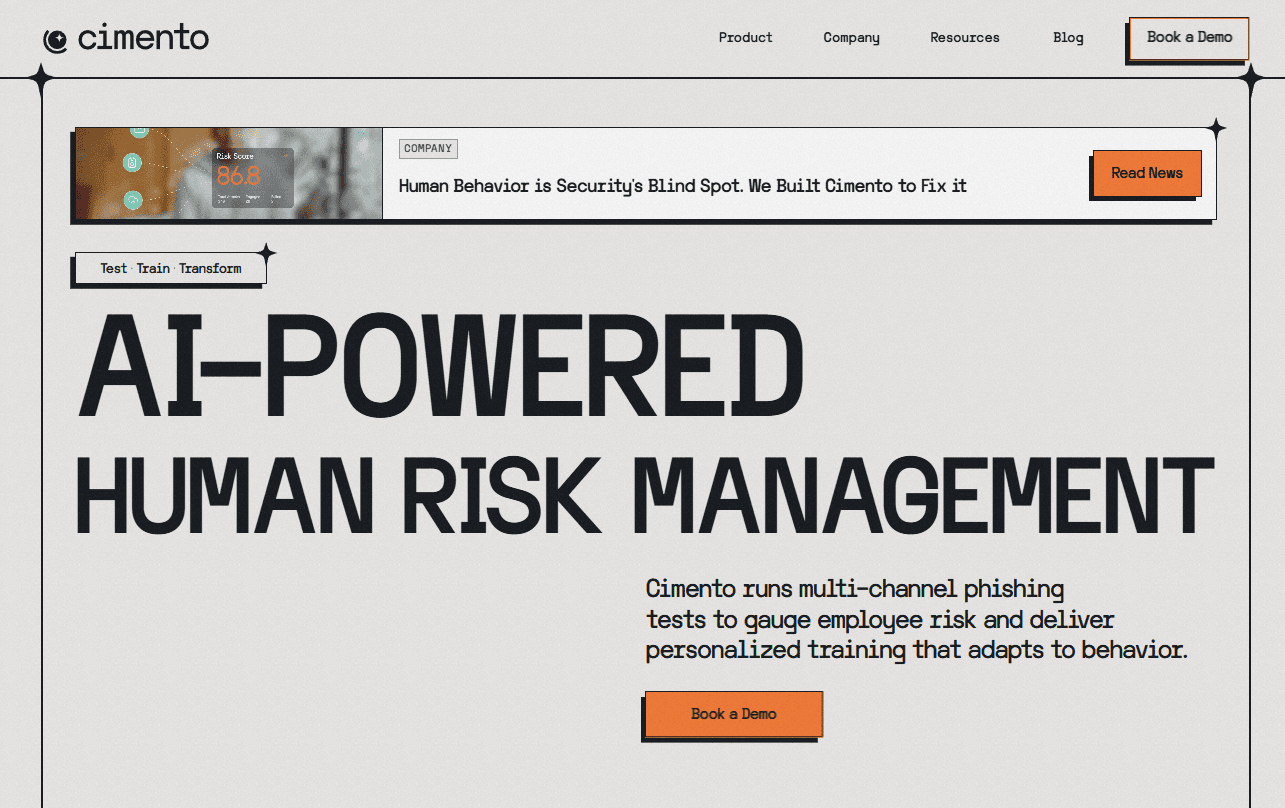
Cimento is built AI-native from the ground up rather than AI features layered onto an older training platform. The core idea is straightforward: an employee's risk and the risk of any AI agent that employee runs are the same measurement problem, just applied twice. The agent inherits the person's access, the person's judgment about what to trust, and by extension the person's exposure. Cimento treats it that way rather than shipping a separate agent-security product with its own dashboard.
On the human side, the platform combines several capabilities into a single workflow:
Multi-channel simulations across email, SMS, voice, and messaging apps that adapt based on each user's responses.
Personalized training modules tailored to role, current risk level, and recent behavior.
Deep integrations with Okta and Azure AD that can automatically trigger access changes when a user's risk score crosses a threshold.
Living employee risk scores that updates based on simulation performance, behavioral patterns, signals from HRIS, SIEM, and other security tools.
AI agent security assessment that runs adversarial tests, detects vulnerabilities, scores agent risk, and auto-generates remediation guidance.
The agent side of this is still emerging across the industry. Cimento extends the same risk framework to AI agents instead of treating agent security as a separate category, which is a different architectural approach from most vendors. Cimento also reports that its behavior-based nudges increase training completion by roughly 40%, though this is a vendor-reported figure rather than an independently audited result. See it live for yourself.
Best fit: teams that want one coherent risk picture across people and the AI agents they run, and are comfortable with a newer, AI-native vendor over an established incumbent.
Related Read: Human Behavior is Security's Blind Spot. Cimento Fixes it
2. KnowBe4

KnowBe4 is the largest name in the space in terms of content library and market presence, and its AIDA suite (AI Defense Agents) is the company's answer to the shift toward HRM, producing a per-user Virtual Risk Officer score alongside its existing training and phishing infrastructure. Notably, KnowBe4 has also moved directly into agent security with a dedicated Agent Risk Manager product and messaging aimed squarely at protecting both employees and the AI agents they use.
The tradeoff is architectural. KnowBe4's human risk scoring and its agent risk tooling currently read as two adjacent products rather than one unified score, and the platform's center of gravity is still closer to training-plus-simulation than to a ground-up behavioral risk engine. For organizations already standardized on KnowBe4, extending into AIDA is the path of least resistance.
Best fit: existing KnowBe4 customers extending into HRM, and organizations that weight content breadth and brand recognition heavily.
3. CybSafe
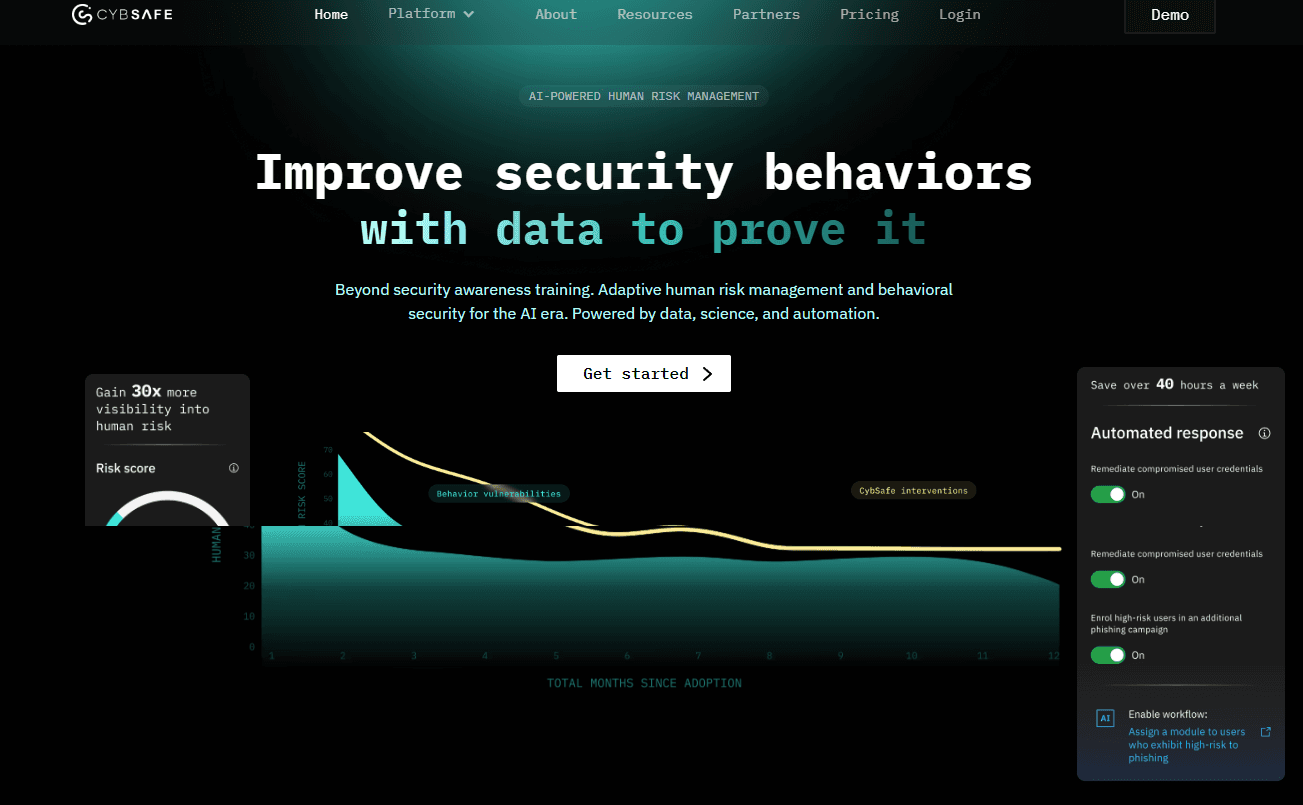
CybSafe was named a Leader in the Forrester Wave for Human Risk Management, and its approach is grounded in behavioral science rather than content volume. A structured taxonomy of specific security behaviors sits underneath the platform, and interventions target those behaviors directly rather than generic topics.
The content library is narrower than the larger, SAT-derived platforms, and some customers pair CybSafe with another tool purely for training volume. It is priced and positioned for enterprise.
Best fit: security teams and audit conversations that want a genuinely evidence-based behavioral model over a broad content catalog.
4. Living Security
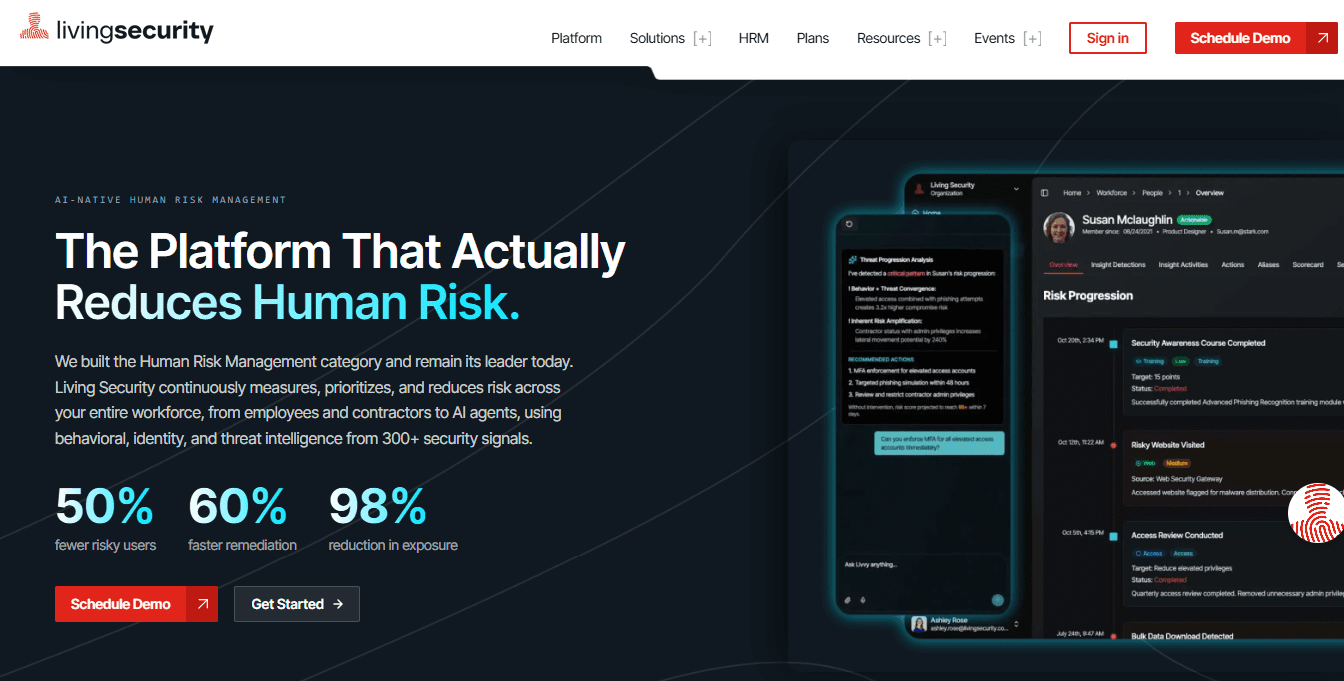
Living Security's Unify platform pulls in behavioral signal from a wide range of existing security integrations, correlating identity, email security, DLP, and endpoint data alongside training and phishing outcomes into a single risk index. For organizations with a mature security stack already generating that telemetry, this cross-tool aggregation is the core value.
That same strength is the limitation for smaller teams: the platform is built to be fed by an existing integration surface, and organizations without one will not see the full picture it is capable of producing.
Best fit: enterprises with mature, well-integrated security operations wanting a genuinely cross-stack risk view.
5. Hoxhunt
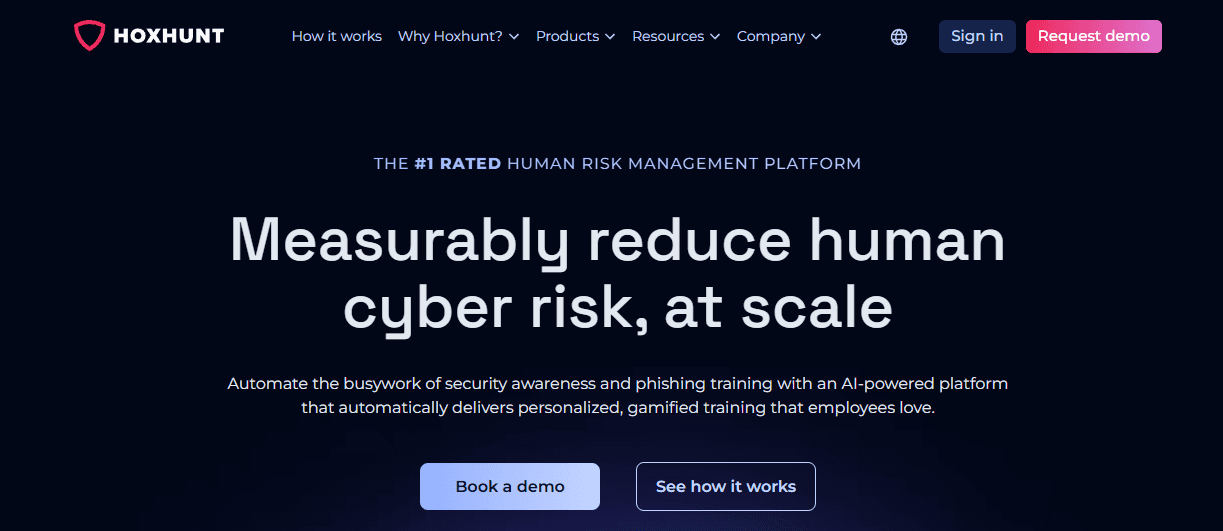
Hoxhunt centers on engagement, using AI-driven adaptive difficulty so each employee's simulations track their current skill level, paired with gamification and a strong emphasis on real threat reporting rather than simulation performance alone. Multi-channel simulation covers email, Slack, and Teams, with deepfake-based executive impersonation training as a notable addition.
Policy management and broader compliance workflows are lighter than dedicated HRM-native platforms, and some customers pair Hoxhunt with a separate tool to cover that gap.
Best fit: organizations where reporting rates and sustained engagement are the primary metric of success.
6. Proofpoint
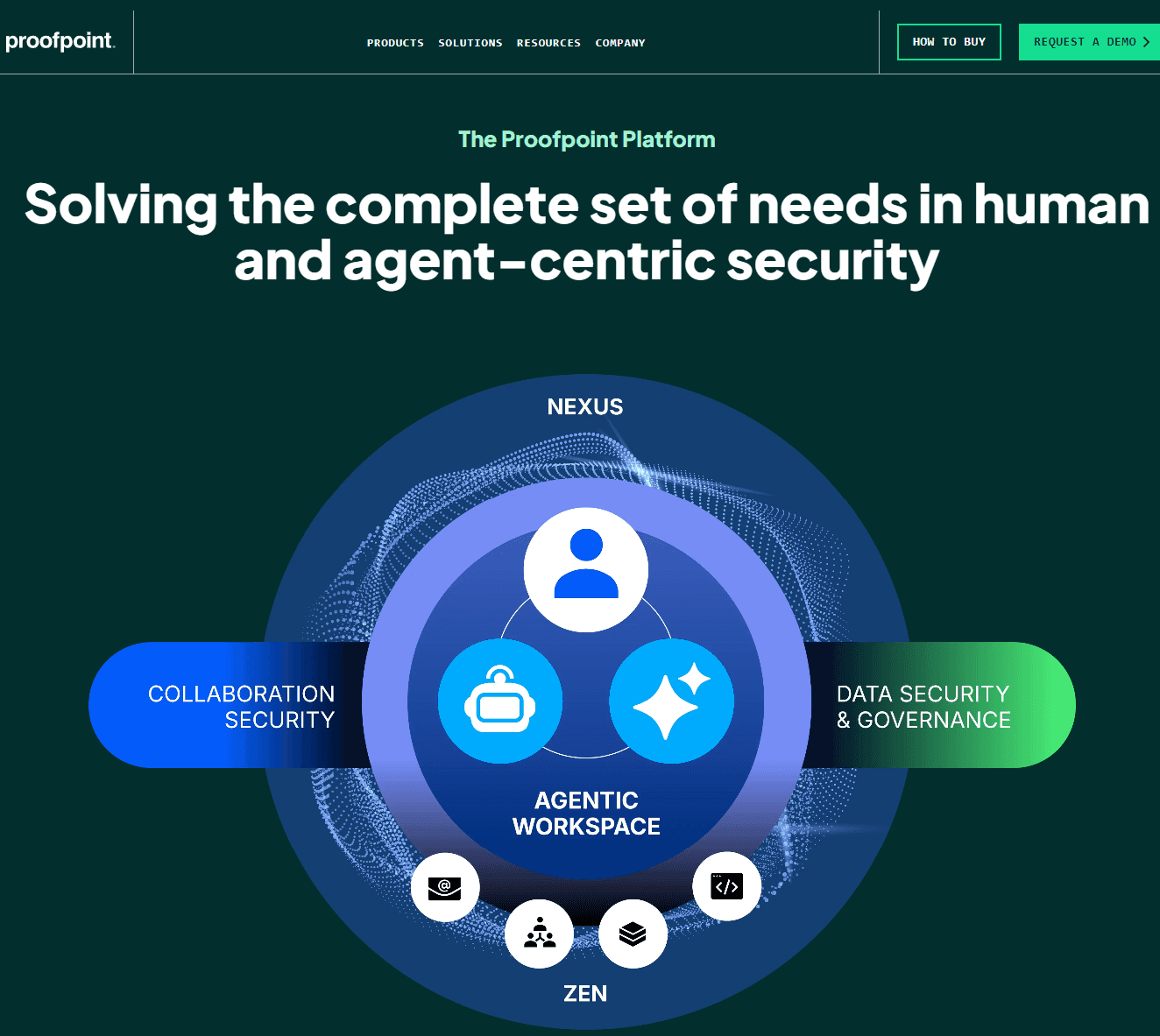
Proofpoint's People Risk Explorer combines training and simulation data with the company's own email threat intelligence, so risk scoring reflects not just who clicks but who is actually being targeted by real attacks. For organizations already running Proofpoint's email security, this integration is a meaningful and specific advantage.
As a standalone HRM platform outside that ecosystem, Proofpoint is less flexible, and the training experience itself tends to be more compliance-oriented than adaptive.
Best fit: enterprises already running Proofpoint email security who want risk scoring tied to real threat-targeting data.
7. Mimecast
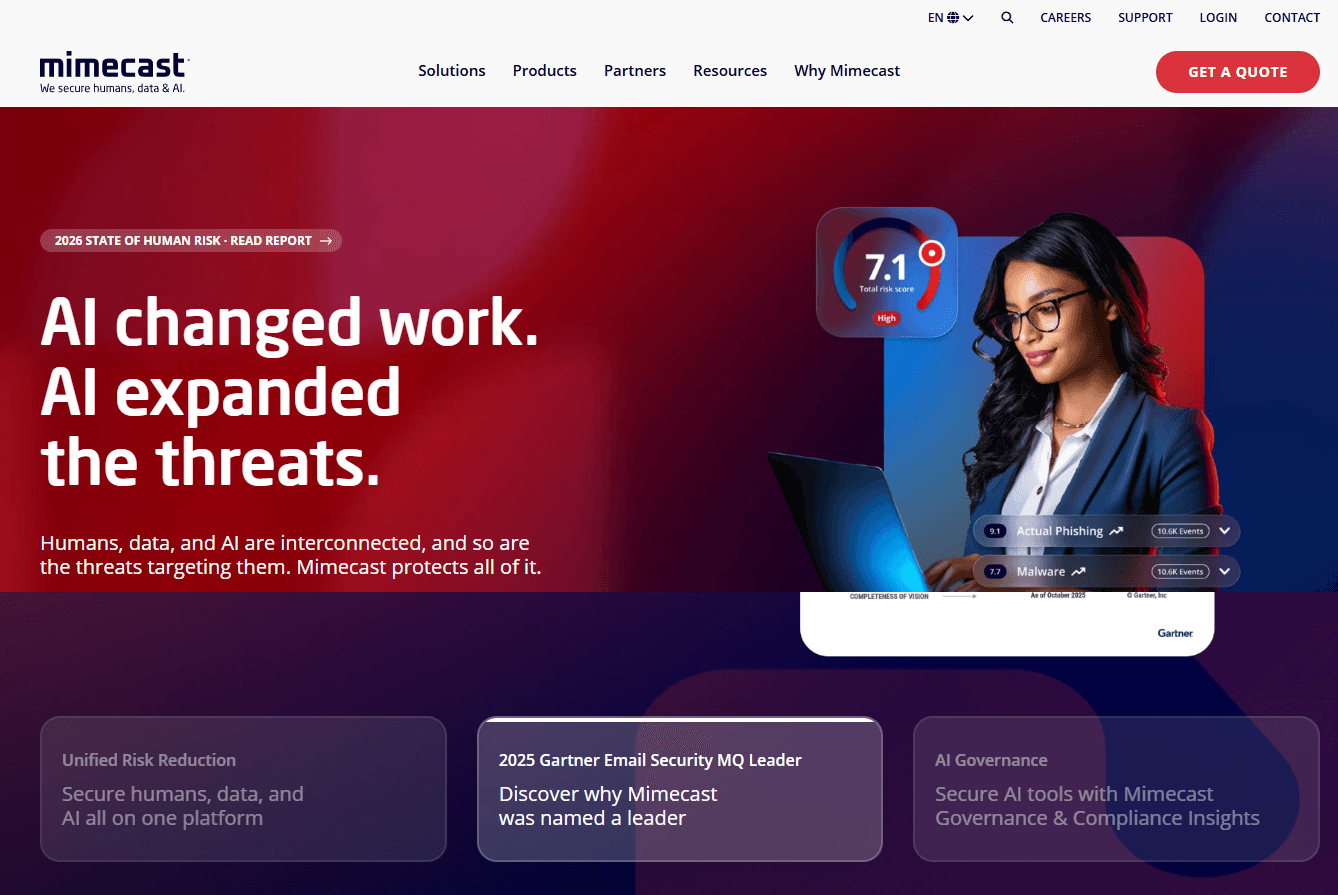
Mimecast models human risk as a composition of behavior, active threats, and identity-based access, run across its large existing customer base and reinforced by the earlier Elevate Security acquisition. For organizations already on Mimecast for email, the HRM layer sits naturally on top of infrastructure that is already generating relevant signal.
Outside the Mimecast ecosystem, the platform is a considerably less compelling standalone choice, and the human-risk capability still reads as an extension of email security positioning rather than a ground-up behavioral platform.
Best fit: existing Mimecast customers who want HRM tied directly to email threat intelligence they already have.
8. SoSafe
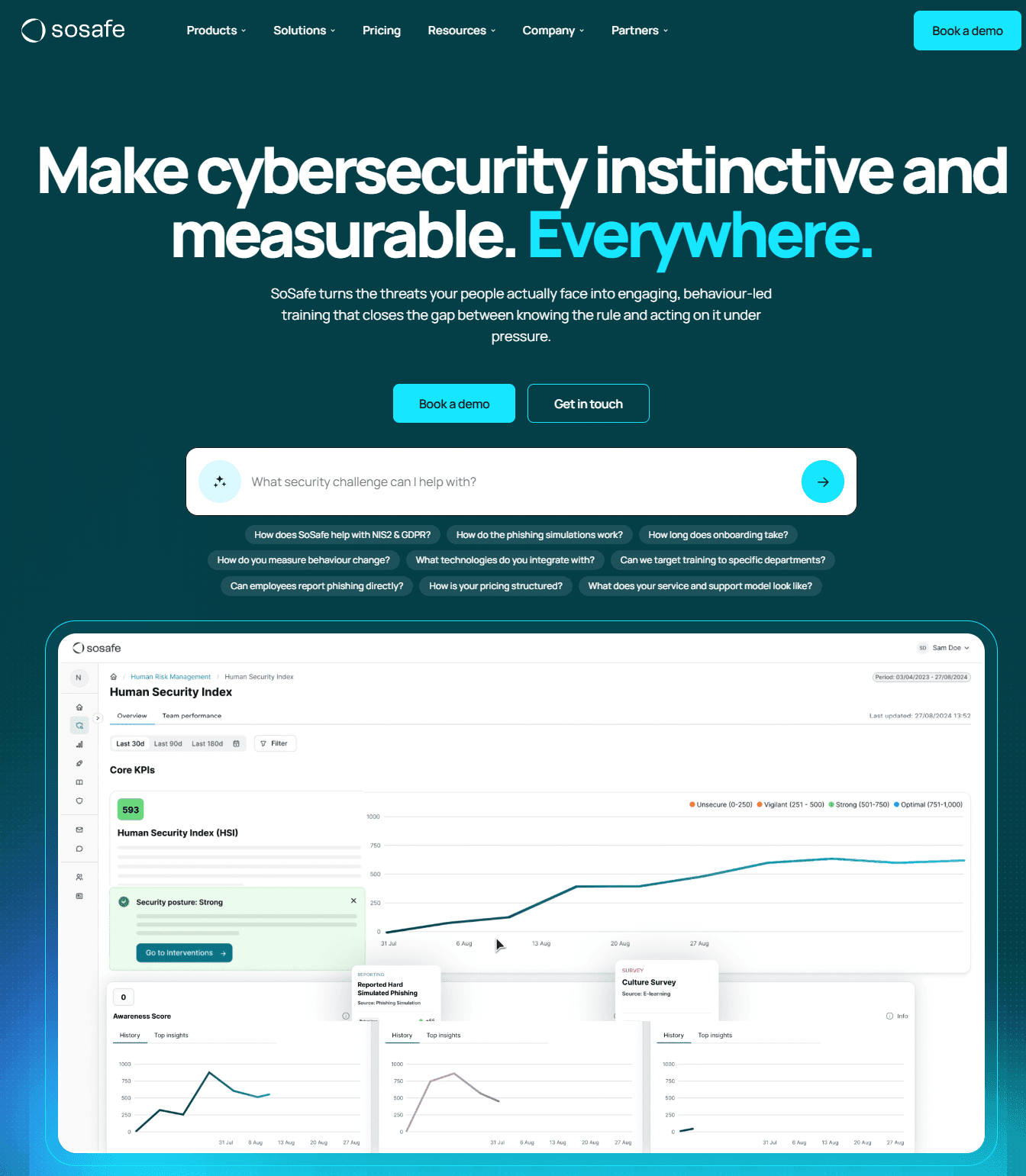
SoSafe has evolved from gamified security training into genuine HRM territory, anchored by an adaptive difficulty engine and the Sofie AI assistant, which delivers real-time coaching inside tools like Teams, Slack, and email at the moment a risky action happens. For European organizations, EU data hosting and privacy-by-design posture remain a clear differentiator against US-based competitors.
The risk-scoring depth is improving but still sits closer to the SAT-with-strong-features end of the spectrum than the fully HRM-native end occupied by platforms like CybSafe or Living Security.
Best fit: EU organizations and MSPs prioritizing data residency alongside a modern, AI-assisted training experience.
9. CultureAI
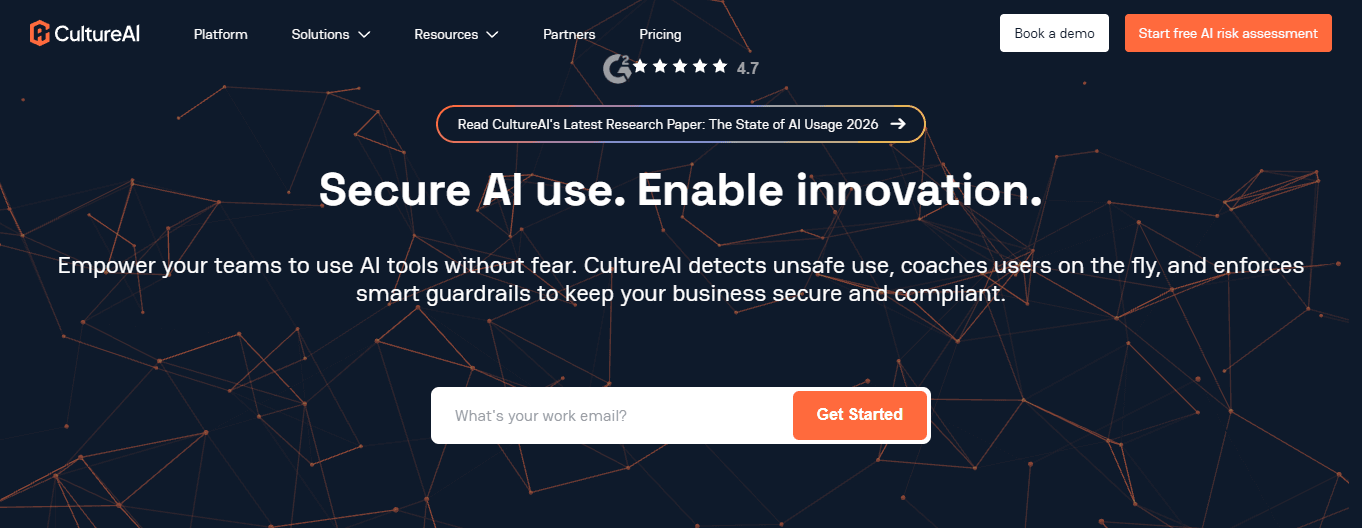
CultureAI takes a point-of-risk approach: rather than scheduled campaigns, it detects risky behavior as it happens across the SaaS stack, things like credential exposure or sensitive data shared in the wrong place, and intervenes immediately, sometimes with an automated fix, sometimes with an educational nudge.
The platform is younger and smaller than the established players, with a narrower content library, and its strength in real-time detection is not yet matched by equally mature structured training or compliance reporting.
Best fit: organizations with extensive Microsoft 365, Google Workspace, or broader SaaS footprints wanting real-time behavioral intervention.
How to Choose the Right Human Risk Management Platform
There is no single best answer here, only the best fit for what you are actually trying to measure and who is doing the measuring.
If you want one coherent risk model across employees and the AI agents they run, Cimento is built around that premise specifically, though it is worth being clear-eyed that the agent side of any vendor's offering, including Cimento's, is still an emerging capability across the entire market.
If your board and audit conversations run on behavioral science and evidence, CybSafe and Living Security are the two names built specifically for that conversation.
If engagement and reporting rates are your current biggest gap, Hoxhunt is the strongest play.
If you are already standardized on an email security vendor, Proofpoint or Mimecast let you extend into HRM without adding a new vendor to the stack.
If you operate in the EU and data residency is non-negotiable, SoSafe is the clearest fit.
If real-time, in-workflow intervention is the gap, CultureAI and Right-Hand are the most distinctive options, at different levels of platform maturity.
If breadth of content and brand familiarity with auditors matters most, KnowBe4 remains the default, particularly now that it is extending into agent risk territory of its own.
Whatever you land on, get hands on with at least two before signing anything. Every platform above demos well. Fewer of them hold up once you are asking your own data the hard questions.
FAQs About Best Human Risk Management Platforms
1. What is the difference between human risk management and security awareness training?
SAT tracks whether people finished training. HRM tracks what they actually do, scores their risk based on real behavior, and automatically responds when that risk changes.
2. Why does human risk management matter now?
About 90% of breaches involve a human element, and years of training-completion tracking hasn't fixed that. Boards and auditors now want proof of behavior change, not attendance records.
3. What is a human risk score?
A number, per person (and often per team/org), that reflects how risky someone's actual behavior is. It updates continuously and triggers automatic action when it crosses a threshold.
4. Do AI agents actually belong in a human risk management platform?
Yes, in principle: an agent inherits its risk from the person who configured it, so it's an extension of that person's exposure, not a separate thing. In practice, most vendors (including Cimento) are still early here, so treat any vendor's agent claims with some skepticism right now.
5. Is a bigger content library the same thing as a better HRM platform?
No. A big library just means more training content. It says nothing about whether the platform measures real behavior or automates a response to it.
6. How much does human risk management software cost?
Custom, per-user pricing across almost every vendor. No public price lists. Judge it by risk reduction delivered, not the sticker price.
Key Takeways
Prioritize platforms that continuously measure behavior and automate responses instead of simply tracking training completion.
Compare vendors based on your organization's needs, whether that's AI agent visibility, behavioral science, compliance, or existing security integrations.
Validate vendor claims with live demos and your own security workflows before making a purchasing decision.
Choose the platform that best fits your environment rather than the one with the largest content library or strongest brand recognition.


