
Highlights
Proofpoint alternatives now split into two categories: better email tools or continuous human risk platforms.
Eleven competitors offer different strengths, from deepfake simulation to adaptive training and MDR.
AI agent exposure is becoming a key differentiator in modern human risk management.
11 Best Proofpoint Alternatives & Competitors (2026)
Proofpoint was built to stop phishing emails. That's still mostly what it does. But attackers don't confine themselves to your inbox anymore, and if your human risk program doesn't cover SMS, voice, deepfakes, and the AI agents your employees now run, you're defending half the surface.
That's the switching trigger behind most Proofpoint alternatives searches in 2026: budget is approved, the incumbent isn't keeping up, and the team evaluating replacements wants to know what actually stops modern human-risk exposure instead of just email spam.
Below are 11 real alternatives, what each is actually good at, where each falls short, and who each one fits. We'll also cover what to check before you sign with any of them.
Why Teams Are Looking Beyond Proofpoint
The old model asked one question: did the email get through, and did the employee click it? That's a snapshot, taken once, usually during onboarding or an annual refresh.
The newer approach asks a different question: how likely is this specific person to be compromised right now, across every channel an attacker might use, and what should you do about it today? That's a continuous, adaptive measurement, not a training completion checkbox.
Proofpoint's architecture is built for the first question. It's a strong email gateway. It wasn’t designed to model a multi-turn attack that starts with a LinkedIn message, moves to a text, and ends with a cloned voice call, because that attack never touches the inbox Proofpoint is watching. If your evaluation criteria still stop at "does it catch phishing emails," you're benchmarking against 2018.
What to Look for in a Proofpoint Alternative
Before you get into named vendors, know what you're actually scoring them against:
Multi-channel coverage. Email, SMS, voice, and deepfake simulation, not just email.
Continuous risk scoring. A live, behavior-based number per person, not a quarterly training completion report.
Agent exposure. Does the platform account for the AI agents and MCP-connected tools your employees now run, or does it stop at the human?
Real-time signal integration. Does it pull from your SIEM, HRIS, and IDP to catch exposure changes as they happen, or only at scheduled intervals?
Reporting a CISO can actually use. Can you show the board a risk trend, not just a completion percentage?
The 11 Best Proofpoint Alternatives in 2026
1. KnowBe4

The category incumbent by sheer library size. KnowBe4 has the deepest catalog of training content and simulated phishing templates in the market, and its brand recognition makes procurement easy.
The gap: it's still primarily a training-completion and simulated-click-rate platform. Recent product moves toward agent risk scoring are early, and the model isn't built around a single continuous per-person score the way newer platforms are.
G2 rating: 4.6/5
Strengths:
Largest training content library in the category, by a wide margin
Long track record and broad enterprise procurement familiarity
Strong incident-response add-on (PhishER) for teams that want it bundled
Tradeoffs:
Still primarily a training-completion and simulated-click-rate platform
Agent-risk scoring is a recent, early-stage addition, not built into the core model
Reporting centers on completion percentages more than a continuous risk score
Best fit: large enterprises that want breadth of content and don't mind a training-metric-first reporting model.
2. Cimento
Cimento measures the same thing Proofpoint was trying to measure, just continuously and across every channel instead of once a year at the inbox. It scores each person's real-time exposure using behavior and simulation data, not training-completion percentages, and covers email, SMS, voice, and deepfake scenarios as part of one model instead of bolted-on modules.
The gap: it's a newer entrant than KnowBe4 or Proofpoint, so the reference-customer base is smaller. If your evaluation weights "years in market" heavily, factor that in.
Strengths:
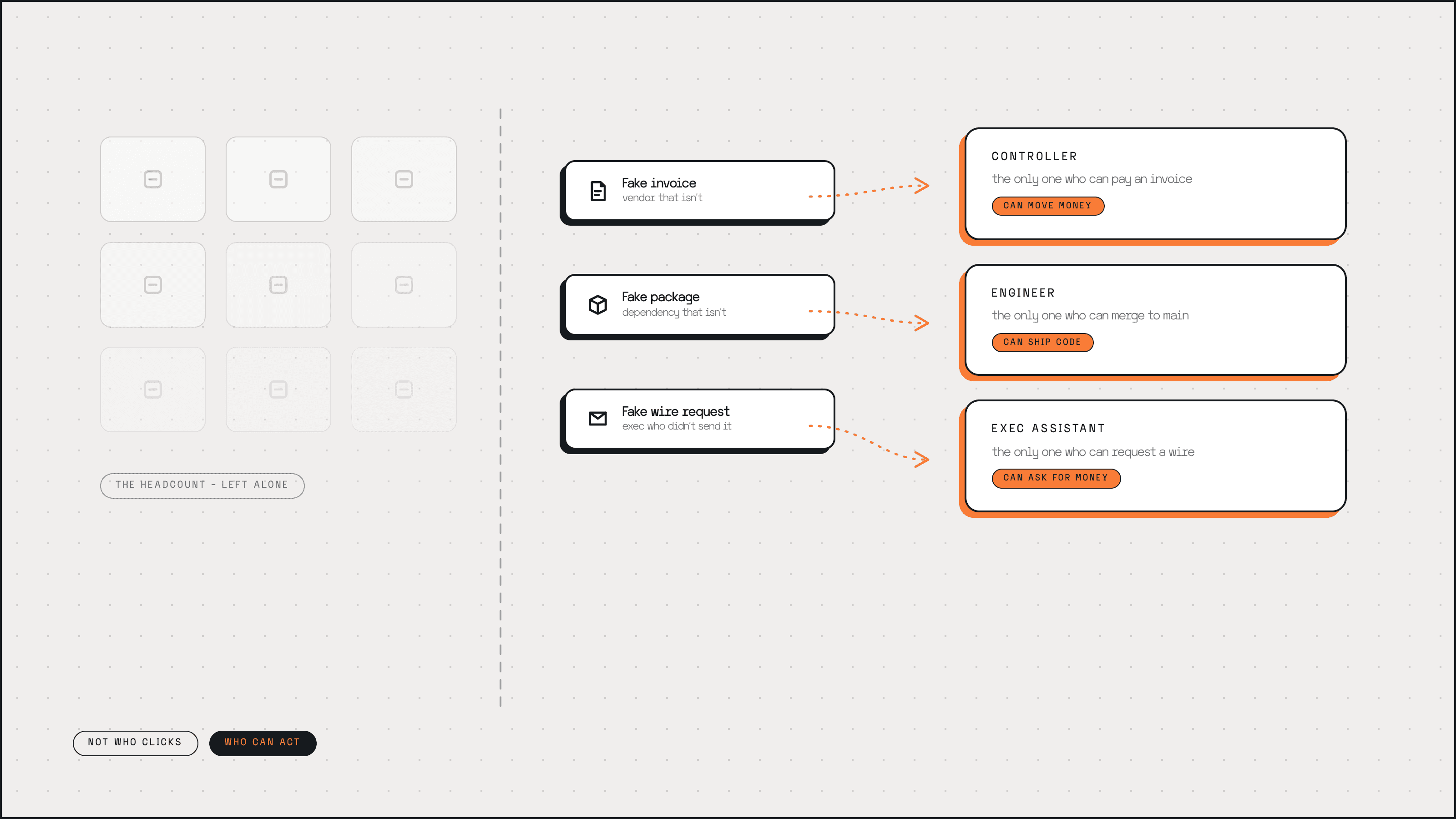
One risk profile, extended to AI agents. Every employee's AI agents inherit that person's risk profile.
Agent activity becomes part of the same score. If someone connects an MCP server or points an agent at a repository, that agent's exposure contributes to their overall risk because it is still delegated exposure.
Designed for the scale of AI execution. An agent can execute thousands of actions a day and can be manipulated through something as simple as a paragraph of text.
Not a separate product or bolt-on module. While some platforms offer standalone agent-risk capabilities, Cimento treats human and agent exposure as the same underlying measurement.
The result: one unified, per-person view of risk across human behavior, simulations, communication channels, and delegated AI agents.
Tradeoffs:
Newer entrant than KnowBe4 or Proofpoint, so the reference-customer base is smaller
Not yet reviewed on G2, so there's no third-party review volume to benchmark against
If your evaluation weights "years in market" or public review count heavily, factor that in.
Best fit: security teams that want one continuous risk score covering human behavior and agent exposure together, not two separate tools reporting two separate numbers.
3. SoSafe
SoSafe has strong footing in European and GDPR-conscious markets, with localization and compliance framing that resonates with EU security teams specifically.
The gap: the platform is still rooted in security-awareness-training messaging and structure, even as it adds newer capabilities.
G2 rating: 4.5/5
Strengths:
Strong data-residency and GDPR-aligned positioning for EU buyers
Reviewers consistently praise ease of use and onboarding speed
Visually polished, contemporary training content
Tradeoffs:
Still rooted in security-awareness-training messaging and structure, even as it adds newer capabilities
Reviewers note reporting and simulation depth lag behind more advanced platforms
Limited customization relative to larger content libraries
Best fit: EU-headquartered or EU-regulated organizations prioritizing compliance-aligned training.
4. Abnormal Security

Abnormal built its name on AI-driven behavioral detection at the email layer, catching business email compromise and vendor fraud that signature-based filters miss.
The gap: it's a detection tool, not a human-risk-scoring platform. It tells you what got through, not how likely each person is to be the next target.
G2 rating: 4.8/5
Strengths:
High-precision AI behavioral baselining catches account takeover and BEC that signature-based tools miss
Reviewers consistently praise fast, low-disruption implementation
Strong quality-of-support scores relative to category peers
Tradeoffs:
It's a detection tool, not a human-risk-scoring platform
Tells you what got through, not how likely each person is to be the next target
No training, simulation, or agent-risk component
Best fit: teams that want to harden the email layer specifically and will pair it with a separate human-risk program.
5. Hoxhunt
Hoxhunt's gamification approach genuinely moves engagement numbers, and its behavioral-science backing is one of the more credible in the category.
The gap: channel coverage skews toward email and light SMS simulation. Voice and deepfake scenarios are less mature than platforms built human-risk-first from day one.
G2 rating: 4.8/5
Strengths:
Highest G2 review volume of any platform on this list, with consistently strong satisfaction scores
Gamified engagement mechanics reviewers repeatedly single out as effective
Adaptive difficulty tuned to individual behavior over time
Tradeoffs:
Channel coverage skews toward email and light SMS simulation
Voice and deepfake scenarios are less mature than platforms built human-risk-first from day one
No agent-risk modeling
Best fit: teams that have struggled with training engagement and need a program employees actually participate in.
6. Adaptive Security
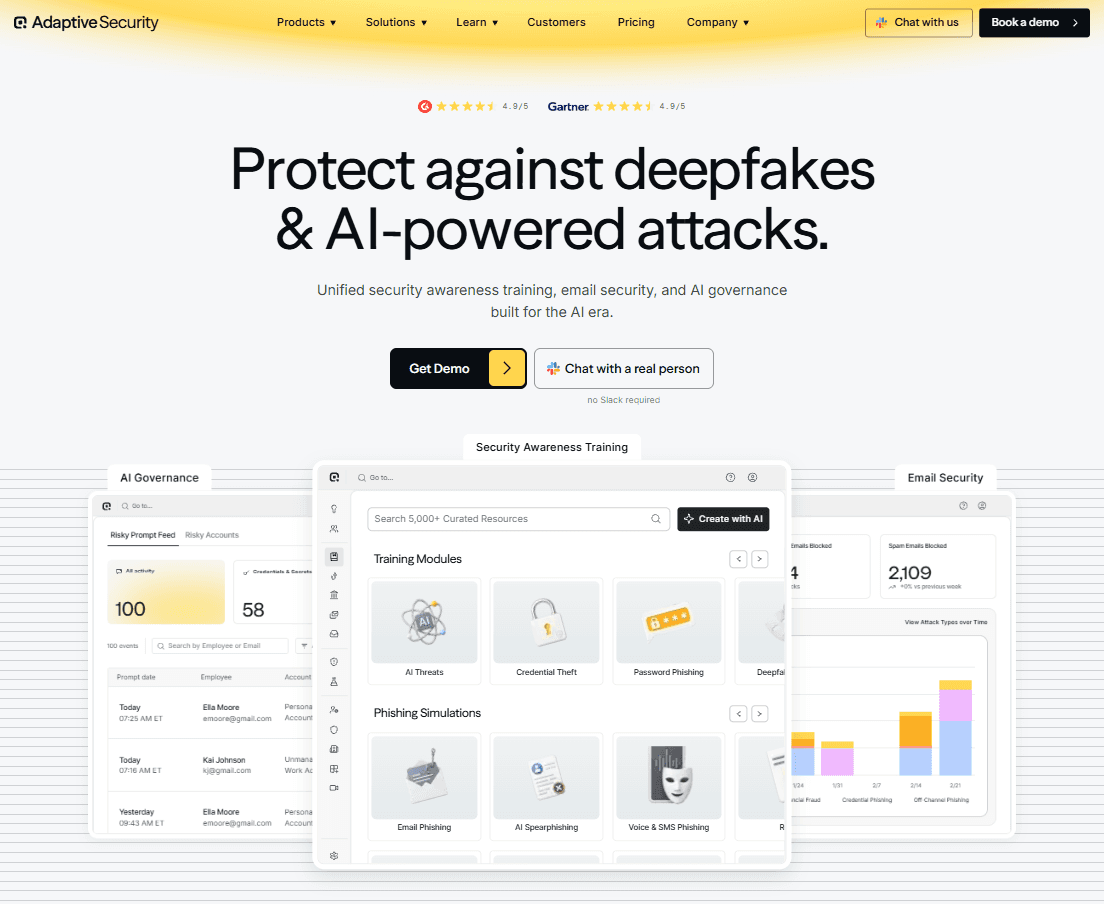
Adaptive has built specific strength in deepfake and voice-clone simulation, an area most of the category still treats as an afterthought.
The gap: it's narrower in scope than a full human-risk platform. Strong on deepfake specifically, thinner on the broader multi-channel picture.
G2 rating: 4.9/5
Strengths:
Highest G2 star rating of any platform on this list
Realistic, fast-to-deploy deepfake and voice-clone simulation reviewers call out specifically
Strong momentum among teams migrating directly from KnowBe4
Tradeoffs:
Narrower in scope than a full human-risk platform
Strong on deepfake specifically, thinner on the broader multi-channel picture
Small review base relative to established players, so satisfaction signal is still building
Best fit: organizations with high executive-impersonation risk who want deepfake simulation as a standalone priority.
7. Fable Security

Fable's product experience is a genuine differentiator. The interface and workflow feel built for 2026, not adapted from a 2015 training portal.
The gap: as a newer platform, deployment scale and reference customers are still building out compared to established players.
G2 rating: 4.9/5
Strengths:
Native Slack integration and near-real-time briefings reviewers highlight as standout
Modern interface and workflow, not adapted from a legacy training portal
Flexible content generation (AI-augmented or human-authored) to match audience tone
Tradeoffs:
As a newer platform, deployment scale and reference customers are still building out compared to established players
G2 review volume is too thin to draw firm satisfaction conclusions from yet
Less proven at enterprise scale than category incumbents
Best fit: teams that weigh UI/UX and day-to-day usability heavily in vendor selection.
8. Huntress

Huntress's core strength is managed detection and response at the endpoint, with a strong reputation among IT teams for fast, hands-on threat response.
The gap: human-risk scoring is a secondary layer on top of an MDR-first product, not the core architecture.
G2 rating: 4.8/5
Strengths:
Very high review volume and satisfaction score, driven mostly by its MDR/EDR product
Analyst-backed 24/7 SOC reviewers describe as genuinely hands-on, not automated summaries
Fast, lightweight deployment praised across thousands of reviews
Tradeoffs:
The G2 rating reflects the MDR/EDR product, not a dedicated human-risk or SAT offering
Human-risk scoring is a secondary layer on top of an MDR-first product, not the core architecture
Worth flagging editorially: Huntress is fundamentally an MDR platform, so including it in an HRM comparison is a partial fit at best
Best fit: organizations that already value Huntress for endpoint/MDR and want human-risk visibility as an add-on rather than a standalone platform.
9. Dune Security
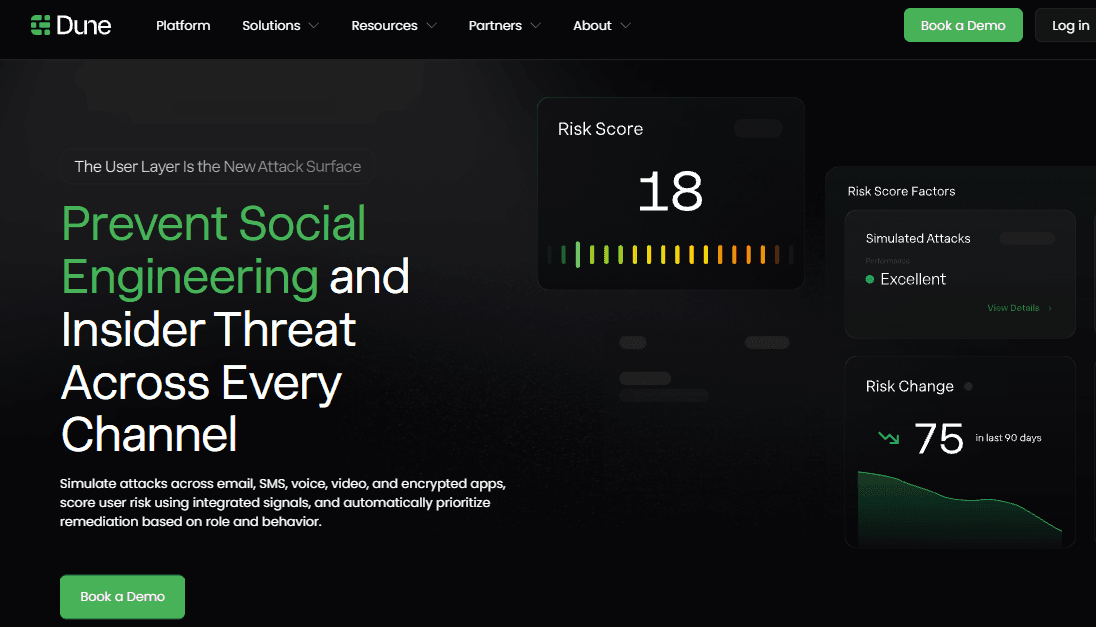
Dune positions around risk-based, adaptive training that adjusts based on individual behavior patterns rather than a one-size-fits-all curriculum.
The gap: coverage and market presence are still developing relative to more established human-risk platforms.
Strengths:
Adaptive, individually personalized training paths rather than one-size-fits-all curriculum
Early positioning specifically around risk-based training personalization
Tradeoffs:
No public G2 review base yet, so third-party validation is essentially unavailable
Coverage and market presence are still developing relative to more established human-risk platforms
Harder to benchmark claims against independent customer feedback right now
Best fit: teams specifically prioritizing personalized training paths over broad simulation coverage.
10. Cofense PhishMe
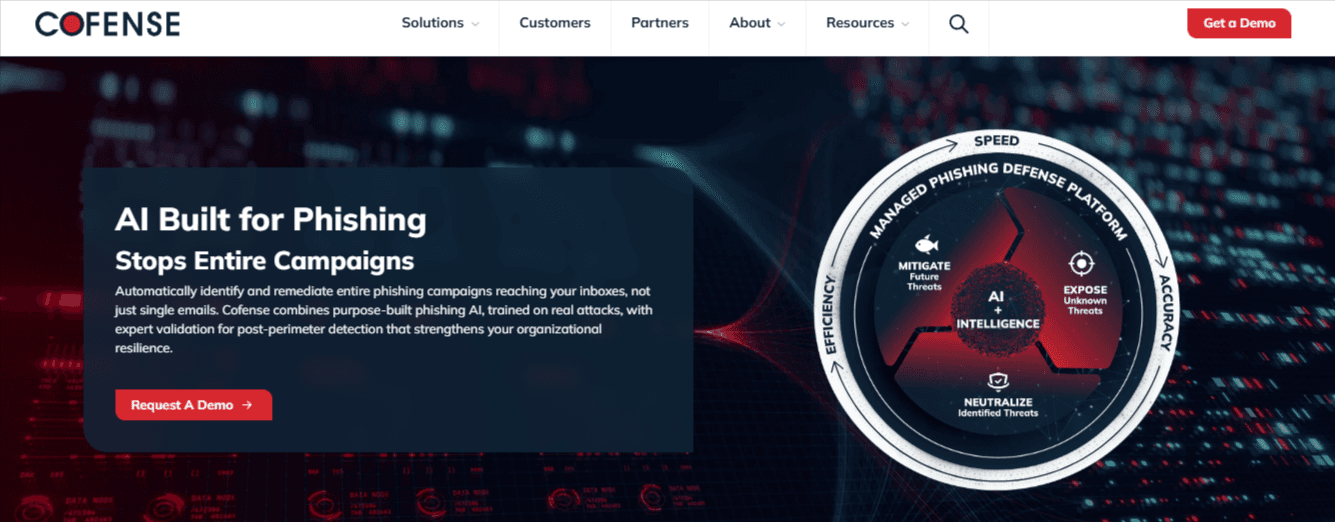
Cofense built its name on crowdsourced threat intelligence, using real employee-reported phishing emails to sharpen detection across its customer base.
The gap: the model is still centered on email reporting and simulation. Multi-channel and agent-risk coverage aren't core to the product.
G2 rating: 4.4/5
Strengths:
Crowdsourced threat intelligence from real employee-reported phishing emails
Long-standing reputation specifically for email incident triage and reporting workflows
Broader review base on Gartner Peer Insights (130+ reviews, 4.7/5) than currently reflected on G2
Tradeoffs:
The model is still centered on email reporting and simulation
Multi-channel and agent-risk coverage aren't core to the product
Some reviewers note cost concerns for smaller organizations
Best fit: organizations that want to lean on employee-reported threat intelligence as a core input to their email defense.
11. Mimecast
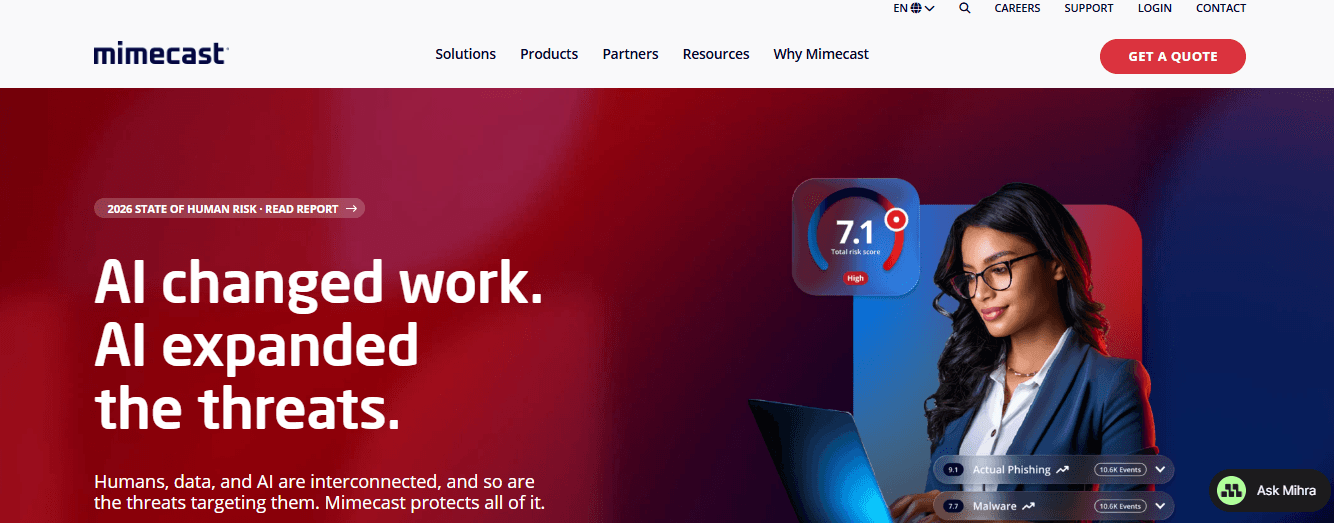
Mimecast is one of Proofpoint's closest direct competitors, going head-to-head on email security gateway features, archiving, and continuity.
The gap: it's built on the same structural foundation as Proofpoint. If your reason for leaving Proofpoint is "email-only isn't enough anymore," a same-category competitor doesn't solve the underlying problem.
G2 rating: 4.4/5
Strengths:
Strong, consistent reviewer praise for phishing, malware, and impersonation protection
AI-driven multi-layer detection reviewers cite as a standout capability
Seamless Microsoft 365 integration for fast deployment
Tradeoffs:
Built on the same structural foundation as Proofpoint
If your reason for leaving Proofpoint is "email-only isn't enough anymore," a same-category competitor doesn't solve the underlying problem
Reviewers note a steeper configuration learning curve for specific workflows
Best fit: teams that specifically want a better email gateway and aren't looking to change their broader human-risk approach.
Proofpoint vs. Cimento: The Core Difference
Proofpoint | Cimento |
Filters email, reports what got blocked | Measures real-time exposure across every channel |
Training completion as the success metric | Continuous, behavior-based risk score per person |
Human risk and agent risk as separate concerns | One score: a person's exposure includes their agents' exposure |
Point-in-time snapshot | Adaptive, updated as behavior and signals change |
The agent-risk piece is worth being precise about. The claim isn't that competitors ignore AI agents entirely; several have started building toward it. The claim is narrower and more defensible: no other platform in this category models agent exposure as part of the same unified per-person score instead of a bolted-on second product.
How to Choose the Right Proofpoint Alternative
Your best fit depends on who's driving the decision:
If you're a CISO reporting risk upward, prioritize platforms with continuous scoring and board-ready reporting over ones that only report training completion.
If you're a security awareness manager running the day-to-day program, weigh engagement and usability heavily. A platform employees actually interact with beats one with a longer feature list nobody opens.
If you're an IT administrator owning integration, check SIEM, HRIS, and IDP compatibility before anything else. A platform that can't pull real-time signal from your existing stack will always be reporting on old data.
Summing It Up…
Proofpoint alternatives split into two real categories: better email tools, and platforms that measure human risk continuously across every channel an attacker actually uses. If your team is still fighting 2018's problem, an email-gateway upgrade might be enough. If you're trying to answer "how exposed is this person right now, including the AI agents they run," you need a platform built around that question from the ground up.
See how a continuous, behavior-based risk score works for your team: Explore Cimento's Human Risk Baseline
Related Articles:
8 Best KnowBe4 Alternatives for Human Risk Management (2026)
Top 10 Hoxhunt Alternatives for Human Risk Management (2026)
10 Best Security Awareness Training Platforms for Technology Companies (2026)
FAQs About Proofpoint Alternatives
1. What is the best alternative to Proofpoint for human risk management?
It depends on what you're optimizing for. Platforms built specifically around continuous, behavior-based risk scoring, like Cimento or Hoxhunt, cover more ground than email-gateway competitors like Mimecast if your goal is measuring human risk broadly rather than just filtering email.
2. Does Proofpoint offer behavior-based risk scoring?
Proofpoint's core strength remains email filtering and training-based awareness programs. Behavior-based, continuous risk scoring across multiple channels is more central to newer human risk management (HRM) platforms.
3. What's the difference between Proofpoint and a Human Risk Management platform?
Proofpoint is primarily an email security gateway with an awareness-training layer. A Human Risk Management platform measures a person's exposure continuously, across channels, and updates that score as behavior and signals change, rather than reporting a point-in-time training result.
4. Can Proofpoint alternatives cover SMS and voice phishing, not just email?
Yes. Several platforms on this list, including Cimento, Adaptive Security, and Hoxhunt, run simulations across SMS and voice channels, not just email. That matters given how much social engineering activity now happens outside the inbox.
Key Takeways
Define whether you need a better email security tool or a broader human risk management platform before comparing vendors.
Prioritize continuous, behavior-based risk scoring if you need visibility beyond training completion and click rates.
Evaluate multi-channel coverage across email, SMS, voice, and deepfake scenarios to reflect modern social engineering.
Check how each platform handles emerging AI agent exposure rather than treating it as a separate future problem.
Match the platform to your primary buyer need, whether that is content breadth, engagement, deepfake defense, MDR, or continuous risk visibility.